
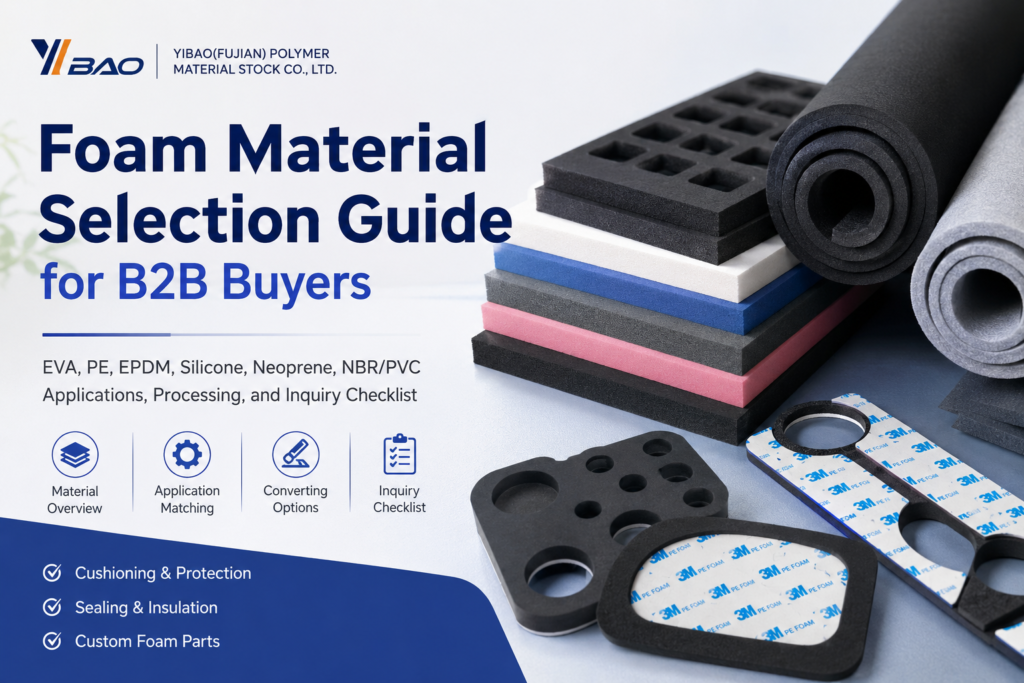
Choosing foam becomes easier when the discussion starts with the part’s job rather than a familiar material name. A packaging insert, sealing strip and adhesive pad may all look simple, but each one fails for a different reason and needs a different material direction.
As a first filter, use PE for lightweight protection, EVA for shaped or visible inserts, EPDM for weather-exposed sealing, silicone when temperature is critical, NBR/PVC for oil-related applications, and neoprene-based foam for flexible laminated parts. This foam material selection guide for B2B buyers shows what must still be confirmed before approving a grade.
The short answer
How to Use This Foam Material Selection Guide for B2B Buyers
Start with PE foam when the job is lightweight cushioning, separation, lining or transport protection. Move toward EVA foam when the part is visible, needs a cleaner shaped cavity or must provide firmer support for tools, products, sports goods or footwear components.
For sealing, the environment carries more weight than appearance. EPDM foam is a practical starting direction for weather-exposed gaskets and compression-recovery applications. Silicone foam deserves consideration when temperature is a key filter. NBR/PVC foam is more relevant when oil-related insulation or flexible industrial sealing is involved. The neoprene, SBR, SCR and CR group is often evaluated for laminated soft goods, flexible pads and balanced rubber-foam parts.
Match the first sample to the main job
A soft sheet may bottom out under the real load. A firm gasket may still be suitable if it seals the actual gap without creating excessive closing force. Test the selected grade in the real assembly.
Before comparing grades
Four Details That Decide the Material Shortlist
A useful inquiry explains what could go wrong. Packaging foam may fail because the product moves, takes impact or touches the carton wall. A gasket may fail because it cannot fill the gap, recover after compression or remain stable in the working environment. An adhesive pad may fail because the tape does not match the real surface.
Part function
State whether the foam cushions, seals, spaces, insulates, protects a surface or controls vibration.
Assembly condition
Provide the available gap, load, contact area, closing method, pressure and expected compression.
Working environment
List heat, moisture, weather, UV, oil, chemicals, dust and whether the part remains visible.
Supply format
Clarify whether you need sheet stock, a strip, gasket, insert, laminated part or adhesive-backed pad.
Suitable, confirm, exclude
Six Foam Families and the Decision Each One Helps Solve
A material family is only a starting direction. Ask which family fits the failure risk, what must be confirmed and what would rule it out. The guidance below builds a focused shortlist without treating every grade as identical.
PE Foam
Suitable whenLow weight, separation, transport cushioning or simple protective pads matter more than a highly finished visible cavity.
Confirm before approvalProduct load, available thickness, bottoming-out risk, contact marks and whether the part will be supplied as sheet, strip or cut pad.
Look elsewhere whenThe job is long-term weather sealing, oil contact, demanding heat exposure or a presentation-grade insert that needs firmer cavity walls.
EVA Foam
Suitable whenVisible inserts, tool control, shaped trays, footwear components or firmer cushioning need clean edges and defined geometry.
Confirm before approvalFirmness, cavity-wall thickness, product removal, repeated handling, surface finish and whether the sample represents the final cut construction.
Look elsewhere whenThe main requirement is soft gap sealing, outdoor weathering, oil compatibility or temperature performance rather than shape and presentation.
EPDM Foam
Suitable whenWeather-exposed gaskets, enclosure seals, sealing strips or anti-rattle pads need compression recovery and environmental resistance.
Confirm before approvalCell structure, installed gap, target compression, closing force, strip joints, mounting surface and the selected adhesive system.
Look elsewhere whenThe priority is a rigid-looking presentation insert, direct oil contact or a temperature requirement better served by another material family.
Silicone Foam
Suitable whenTemperature-sensitive sealing, lighting, electronics or specialty equipment makes heat stability a primary filter.
Confirm before approvalContinuous and peak temperature, compression, required reports or standards, adhesive compatibility, part geometry and project cost target.
Look elsewhere whenThe application is ordinary low-cost packaging or another foam family can meet the environment without the same specialty requirements.
NBR/PVC Foam
Suitable whenOil-related insulation, HVAC parts or flexible industrial sealing requires a material direction that accounts for fluid contact.
Confirm before approvalThe exact fluid, concentration, contact duration, working temperature, expected dimensional change and whether the adhesive sees the same exposure.
Look elsewhere whenNo oil-related condition exists and weather exposure, high heat or visible cavity presentation is the real decision driver.
Neoprene / SBR / SCR / CR
Suitable whenLaminated soft goods, sports supports, flexible pads or fabric-backed components need a balanced rubber-foam construction.
Confirm before approvalFabric or film lamination, touch, stretch, recovery, total thickness, cut-edge appearance and how the finished part will be handled.
Look elsewhere whenThe project needs highly defined rigid cavities or a specific heat, oil or weather requirement that should control the shortlist first.

PE for lightweight protection
Choose this direction for separators, protective liners or simple transport pads tested with the real product load.
View PE Foam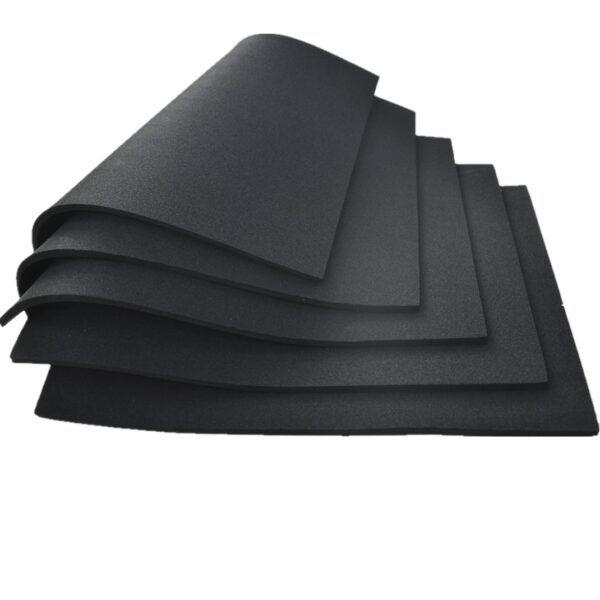
EPDM for weather-focused sealing
Choose this direction when sealing pressure, outdoor exposure and recovery matter most.
View EPDM FoamFrom application to inquiry
Four Common B2B Buying Scenarios
These examples show what a buyer should provide and which sample format is most useful for four common applications.
PE or EVA depends on load and presentation
Provide the product weight, cavity depth, removal frequency and visible-finish requirement. Start with PE when lightweight protection is the priority; compare EVA when firmer cavity walls and a cleaner presentation matter. Approve a cut insert with the real product, not only a flat sheet.
Gap and closing force decide more than thickness
Provide the installed gap, closing method, repeated opening, weather exposure and mounting surface. EPDM is a practical first direction, but the sample must confirm compression, recovery and adhesive performance in the actual enclosure.
The substrate is part of the specification
Name the real surface, including painted metal, smooth plastic or textured plastic, and note dust, oil, heat or vibration. Select the foam for the working environment, then test the backing and liner as part of the finished pad rather than adding tape after approval.
Total construction matters more than the foam layer alone
Provide the fabric or film, layer order, desired touch, stretch, edge appearance and finished thickness. Neoprene-based or related rubber-foam directions may be relevant, but approval should use the laminated and cut part because lamination changes handling and dimensions.
Sheet stock or production-ready part?
When the Project Needs More Than a Raw Foam Sheet
Sheet stock is suitable for early comparison, simple cutting or projects where another factory will complete the part. A production line may instead need die-cut gaskets, adhesive-backed pads, CNC inserts, laminated blocks, strips on release liner or parts packed in a defined orientation.
Discuss the finished construction before material approval. Cutting, adhesive backing, lamination and liner choice can change total thickness, flexibility, edge quality and assembly handling. YIBAO’s foam converting services cover die cutting, CNC cutting, lamination, slitting and adhesive-backed parts.
Put these details on the drawing or inquiry
- Final length, width and thickness
- Critical dimensions and tolerances
- Hole, slot, radius and notch details
- Adhesive and non-adhesive areas
- Liner type and peel direction
- Layer order for laminated constructions
- Individual, sheeted or roll supply format
- Visible side and cleanliness requirements
- Packing orientation and label needs
- Drawing revision and approved sample reference
Sample approval
Check the Finished Part in the Real Assembly
A useful sample review should answer a production question. “The foam feels good” is not an approval method. “The insert controls movement without marking the product” or “the gasket closes without excessive force and recovers after repeated opening” gives the team a repeatable standard.
Fit and force
- Does the part fit without stretching or buckling?
- Does the foam bottom out under the real load?
- Does the gasket create excessive closing force?
- Can the product be removed without damage?
Surface and environment
- Does the foam leave marks, dust or residue?
- Does adhesive bond to the real substrate?
- Does heat, moisture, weather or fluid contact change the part?
- Are reports required for the selected grade?
Production handling
- Can operators peel and align the part easily?
- Do narrow sections tear during removal?
- Does packing keep parts flat and clean?
- Can the same inspection be repeated on bulk orders?
Compare equal constructions
How to Compare Two Foam Quotations Fairly
Two quotations are only comparable when they describe the same finished construction, inspection standard and packing method. Ask suppliers to identify any substitute material or process change clearly.
| Compare this item | Why it changes the result or price | What the quotation should state |
|---|---|---|
| Material and grade | Different formulations within one family may not behave the same way. | Named grade, approved alternative or a clear note that final selection follows sample review. |
| Finished thickness and tolerance | Lamination, adhesive and cutting can change the delivered construction. | Finished thickness, critical tolerances and the dimensions that control fit or sealing. |
| Adhesive and liner | Backing type, coverage and liner handling affect assembly and cost. | Adhesive requirement, bonded area, liner type and peel direction. |
| Converting method | Die cutting, CNC cutting, slitting and lamination create different tooling and handling needs. | Process route, tooling charge if applicable and whether parts are individual, sheeted or rolled. |
| Inspection and sample reference | A quotation is difficult to control if the approved construction is not recorded. | Drawing revision, sample reference and agreed checks for dimensions, appearance and function. |
| Packing and delivery format | Thin gaskets, visible inserts and adhesive parts can deform or collect dust in poor packing. | Quantity per pack, orientation, protective layers, labels and any flatness or cleanliness requirement. |
Prepare a useful inquiry
What to Include in a Foam RFQ
Leave the material open when you are unsure. A clear description of the application and failure risk is more valuable than guessing a grade. The information below helps the supplier recommend a relevant sample and quote the same construction you intend to approve.
Application
- Part name and industry
- Main function
- Failure the foam must prevent
- Indoor or outdoor use
- Prototype or production stage
Performance
- Installed gap or available space
- Load, pressure or compression
- Temperature range
- Moisture, UV, oil or chemical contact
- Mounting surface and adhesive need
Part and order
- Drawing, CAD file or reference sample
- Dimensions and critical tolerance
- Finished format and packing
- Prototype and production quantities
- Required reports and target timing
Related reading
More Specific Guides for the Next Decision
Buyer questions
FAQ About Foam Material Selection
Should I choose the foam material before sending an RFQ?
No. When the material is uncertain, describe the application, failure risk, environment, installed gap and finished format. You may list one or two possible material families, but keep the inquiry open to grade recommendation.
Is thickness enough to request a foam sample?
No. The same nominal thickness can behave differently across materials and grades. Include the installed gap, load or compression, contact surface and planned converting method so the sample can be judged in context.
When should I request a converted sample instead of sheet stock?
Request the finished construction when cutting, adhesive backing, liner handling, lamination or tight fit can change the result. A raw sheet is useful for early screening but may not represent production assembly.
How should I compare two foam quotations?
Compare the same material or approved alternative, finished thickness, dimensions, tolerance, adhesive, liner, processing, packing and sample standard. Prices are not directly comparable when the constructions are different.
Which dimensions should be marked as critical?
Mark dimensions that control sealing, fit, alignment, hole position, adhesive placement or assembly. Cosmetic edges and surfaces that must remain free of adhesive should also be identified.
A practical next step
Send the Part Conditions, Not Just a Material Name
Share the function, drawing, installed condition, environment, contact surface, finished format and quantity. YIBAO can then review a practical material direction and sampling route.