
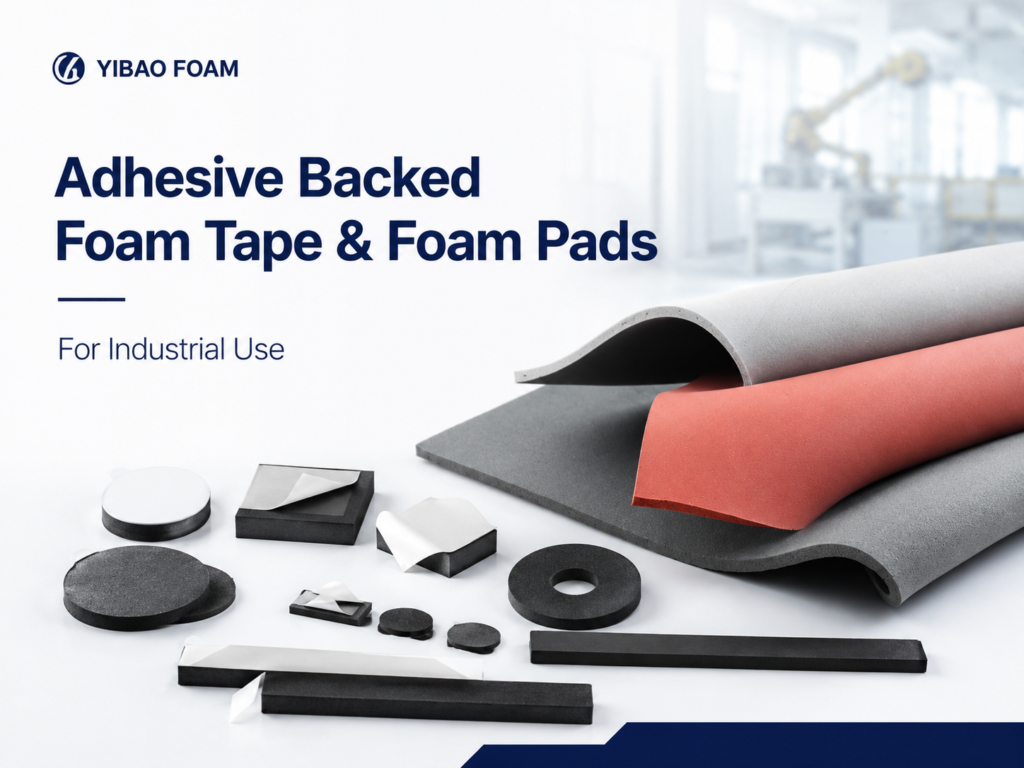
Industrial assemblies use adhesive backed foam tape and foam pads to seal gaps, reduce vibration, protect finished surfaces, maintain spacing and hold soft components in position during assembly. The right solution depends on more than adhesive strength. Foam material, density, compressed height, target surface, liner format, converted shape and working environment must function together.
A foam tape that bonds well to smooth metal may lift from textured plastic. A soft pad that cushions an electronic module may compress too far under a heavier panel. This guide explains how to compare materials, choose one-sided or double-sided backing, evaluate tape and pad formats, test samples and prepare accurate quotation information for industrial production.
Start with the finished assembly
Before selecting a foam name or adhesive type, define what the component must do after installation: seal a gap, absorb vibration, protect a surface, maintain compressed spacing, assist mounting or improve assembly speed. That function determines the appropriate material, thickness, backing and converted format.
In this guide
Foam structure • Tape, pads and gaskets • Material selection • Adhesive and surface • Testing • Quote checklist
What Adhesive Backed Foam Tape and Foam Pads Are
Adhesive backed foam is normally made from a foam substrate, a pressure-sensitive adhesive layer and a removable release liner. Adhesive may be applied to one side for positioning and sealing or to both sides when the foam must sit between and bond two surfaces.
The foam performs the main physical function. Depending on the application, it may compress to fill a gap, isolate vibration, prevent hard contact, protect a coated surface, support a component or reduce movement inside an enclosure. The adhesive keeps the foam in the required position during installation and service.
These two functions must be evaluated separately. High initial tack cannot correct a foam that is too soft, too firm or too thin for the assembly. Likewise, a suitable foam may still fail if the adhesive is applied to an oily, rough, low-surface-energy or heavily textured substrate.
Adhesive backed foam should therefore be specified as an engineered component rather than a generic sticky strip. A cabinet door seal, battery interface pad, display spacer and protective packaging liner may use similar-looking materials, but they face different loads, compression levels and environmental conditions.
Foam Tape, Individual Pads or Gaskets: Which Format Fits the Assembly?
The delivery format affects installation speed, dimensional consistency, material waste and operator handling. Long rolls are practical for continuous edges, while pre-cut pads and gaskets reduce manual cutting and make component placement more repeatable.
| Converted Format | Suitable Uses | Main Advantage | Confirm Before Ordering |
|---|---|---|---|
| Foam tape roll | Long edges, frames, doors, covers and continuous sealing | Flexible cutting and easy storage | Width, roll length, core size, winding direction and joint position |
| Individual foam pads | Local cushioning, anti-rattle contact, mounting assistance and protection | Consistent size and placement | Pad dimensions, adhesive side, liner removal and packing quantity |
| Kiss-cut pad sheet | Small components used in repeat assembly | Fast peeling, counting and handling | Part spacing, sheet layout, liner release and optional pull tabs |
| Frame gasket | Enclosures, panels, equipment doors and perimeter seals | Fewer joints and repeatable shape | Drawing tolerance, corner design, compression and flat packing |
| Spacer or support block | Maintaining distance between modules, covers, glass and housings | Soft contact with controlled thickness | Compressed height, load direction and long-term deformation |
How to Choose the Foam Material
Material selection should begin with compression, recovery, firmness and environmental exposure. PE, EVA, EPDM, silicone, neoprene, CR, SBR, SCR and NBR/PVC foam can all be supplied with adhesive backing, but they do not perform the same job.
The foam substrate should normally be selected before the final adhesive and liner are approved. Once the required softness, thickness and recovery are understood, the backing system can be matched to the installation surface and production method.
| Application Requirement | Common Material Direction | Why It May Fit | What Must Be Tested |
|---|---|---|---|
| Lightweight spacing and packaging protection | PE or EVA foam | Light weight, clean cutting and a useful range of firmness | Density, thickness, surface marking and compression under load |
| Enclosure, door and panel sealing | EPDM, silicone or selected closed-cell foam | Gap filling, resilience and compression recovery | Closing force, compression set, weather exposure and adhesive compatibility |
| Firm support, inserts and positioning blocks | EVA or firmer PE foam | Dimensional stability and controlled support | Final compressed height, tolerance and resistance to permanent deformation |
| Vibration and contact-noise control | EPDM, neoprene, EVA, PE or rubber-blend foam | Soft separation between vibrating or contacting parts | Load, frequency direction, pad area and whether the foam bottoms out |
| Temperature-related elastic sealing | Silicone foam | Elastic recovery and suitability for selected temperature conditions | Actual temperature range, adhesive aging, liner release and assembled compression |
| Flexible industrial pads and insulation | Neoprene, CR, SBR, SCR or NBR/PVC foam | Rubber-like flexibility and adaptable industrial use | Oil contact, heat, residue, marking, compression and adhesive aging |
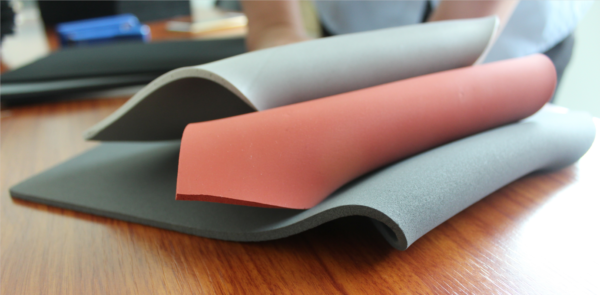
Compare the foam substrate first, then match the adhesive, liner and converting format to the assembly.
One-Sided or Double-Sided Adhesive Backing?
One-sided adhesive backing is commonly used when the foam only needs to be positioned on one component. The exposed foam surface remains available for sealing, cushioning, anti-rattle contact or protective compression.
Double-sided adhesive backing is used when the foam sits between two parts and both surfaces require attachment. It can support panel mounting, layered assemblies, decorative components and applications where the foam provides both spacing and bonding assistance.
| Backing Type | Typical Uses | Main Check |
|---|---|---|
| One-sided adhesive | Gasket positioning, door seals, cushioning pads, protective contact and vibration isolation | Whether the exposed foam face provides the required compression and contact behavior |
| Double-sided adhesive | Mounting assistance, panel attachment, layered parts and two-surface positioning | Peel and shear behavior on both surfaces, especially under continuous load |
Double-sided foam tape should not automatically be treated as a structural fastening system. Vertical installation, continuous shear load, heavy components and safety-related mounting require separate validation. The adhesive, foam body and substrate can each become the failure point.
Match the Adhesive to the Actual Surface
Adhesive performance changes with surface chemistry, texture, cleanliness, application pressure, temperature and dwell time. A result obtained on a clean laboratory panel may not represent a production component with powder coating, mold-release residue, dust or surface curvature.
| Target Surface | Common Risk | Sample-Stage Check |
|---|---|---|
| Smooth metal or glass | Oil, fingerprints, dust or condensation | Cleaning method, contact pressure, initial tack and adhesion after dwell time |
| Painted or powder-coated metal | Surface texture reduces adhesive contact area | Coating texture, adhesive thickness, edge lifting and aging |
| ABS or PC plastic | Mold-release residue and variation between plastic grades | Test on the actual molded component rather than a reference sheet |
| PP or PE plastic | Low surface energy can make bonding difficult | Adhesive compatibility, surface treatment options and long-term edge stability |
| Rubber or silicone-related surfaces | Surface migration or adhesive incompatibility | Residue, transfer, aging and bonding after environmental exposure |
| Curved or uneven surface | Continuous lifting stress and incomplete contact | Foam flexibility, adhesive contact, pad size and edge design |
Release Liner and Assembly Handling
Release liner selection affects peeling speed, part handling, packaging and placement accuracy. Paper liners, film liners, extended liners and tabbed liners support different production methods.
Small soft pads can be difficult to peel if the liner release is too strong. Kiss-cut sheets, split liners or pull tabs may improve operator handling. Long strips require clear specifications for roll direction, slit width, core size and winding quality.
Pressure and Dwell Time
Pressure-sensitive adhesive needs firm and even contact pressure. Light placement may leave air gaps and reduce the effective bonding area. A roller, fixture or controlled press method can improve installation consistency.
Initial tack and developed adhesion are not the same measurement. Some adhesive systems build strength after remaining under pressure for a period of time. Early handling, later peel performance and aging behavior should be evaluated separately.
ASTM D3330 provides standardized methods for measuring peel adhesion of pressure-sensitive tape. It can support comparative testing, but final approval should still use the actual foam, liner, production substrate, application pressure and working environment. View ASTM D3330.
Compression, Load and Finished Assembly Height
Foam thickness on a drawing normally describes its uncompressed condition. A 5 mm foam pad will not necessarily remain 5 mm after installation. The finished height depends on foam density, firmness, contact area, applied load and the amount of compression built into the assembly.
A sealing strip usually needs controlled compression to follow surface variation and close gaps. Too little compression may leave leakage paths. Excessive compression can increase closing force, damage soft foam or reduce its ability to recover after repeated use.
A vibration pad should retain enough thickness to absorb movement. If it becomes fully flattened, the connected surfaces may return to hard contact and the cushioning benefit will fall. A spacer must also be checked at its working load because foam cannot be treated as a rigid plastic standoff.
Dimensions to confirm on the drawing
- Uncompressed foam thickness and tolerance.
- Target installed or compressed height.
- Contact area and load direction.
- Available gap and acceptable closing force.
- Whether the part faces repeated compression or continuous static load.
Common Industrial Applications
Enclosure, Door and Panel Sealing
Adhesive backed foam strips and frame gaskets can fill controlled gaps around covers, doors, housings and panels. They may help reduce dust entry, air leakage, vibration noise and direct contact between rigid surfaces. Gap size, compression recovery, joint design and closing force should be reviewed together.
Anti-Vibration and Anti-Rattle Pads
Foam pads can be installed between metal, plastic, glass or electronic components that may touch or vibrate. The pad area, density and thickness should match the load. Oversized or very soft pads may move under shear, while undersized pads may become fully compressed.
Spacing and Assembly Positioning
Converted foam spacers can support PCB assemblies, display modules, battery pack interfaces, decorative panels, glass components and equipment covers. Adhesive backing holds the part during production, while the foam creates soft contact and controlled separation.
Surface Protection and Packaging Support
Foam pads and liners can separate painted, polished, printed, coated, glass, plastic and metal surfaces during storage or transport. Cosmetic applications should be tested for residue, surface marks, color transfer and the effect of heat, pressure and long contact time.
Foam Converting Options for Production
Foam converting changes sheet or roll material into parts that fit drawings and assembly processes. The most relevant operations for adhesive backed foam tape and pads are adhesive lamination, slitting, die cutting and kiss cutting.
Adhesive Lamination
Lamination applies adhesive and release liner to one side or both sides of the foam. Flatness, pressure, wrinkle control, liner alignment and foam deformation require attention, especially when the substrate is soft or thin.
Slitting and Die Cutting
Slitting produces narrow rolls or strips for long seals and continuous edges. Die cutting creates pads, washers, rings, frame gaskets, holes, slots and custom outlines. The selected process depends on shape, tolerance, volume and how the part will be installed.
Kiss-Cut Sheets and Roll Formats
Kiss cutting separates the foam and adhesive while keeping the carrier liner intact. It is useful for small pads that need organized presentation, fast peeling and accurate counting. Parts can be supplied on sheets or rolls according to the production line and packing requirement.

Foam materials can be laminated, slit and converted into strips, pads, liners, spacers and custom-shaped components.
Testing Before Production Approval
Testing should reproduce the actual installation rather than evaluate the foam by hand feel alone. A sealing part needs compression and recovery checks. A spacer requires confirmation of assembled height. A protective pad should be evaluated for marking and residue. An adhesive backed component must be tested on the real production surface.
The test direction also matters. A vertically installed pad may face continuous shear. A frame gasket may experience stress at corners. A soft pad may stretch while its liner is removed. Heat, humidity, vibration, cold and storage pressure can reveal problems that are not visible during a quick room-temperature test.
| Sample Problem | Possible Cause | What to Review |
|---|---|---|
| Pad releases shortly after installation | Surface contamination, low surface energy or insufficient pressure | Cleaning, adhesive compatibility, press method and dwell time |
| Edges lift or corners curl | Curved surface, stiff foam, oversized part or continuous stress | Foam flexibility, pad geometry, adhesive contact and corner radius |
| Liner is difficult to remove | Release force is too high or the foam is too soft to handle | Film or paper liner, pull tab, split liner or kiss-cut sheet format |
| Seal still leaves a gap | Insufficient thickness, uneven compression or incorrect shape | Gap measurement, installed height, gasket outline and closing force |
| Foam becomes fully flattened | Density, thickness or contact area does not match the load | Working compression, pad area, material firmness and static load |
| Residue or marking appears on the surface | Adhesive, foam color, pressure, temperature or contact time | Long-term cosmetic contact, removal test and realistic storage conditions |
Recommended Sample Checks
- Adhesion on the actual metal, plastic, glass, painted, coated or rubber surface.
- Initial tack and peel performance after the required dwell period.
- Liner peeling after packing and storage.
- Installed compression and final assembly height.
- Edge lifting, curling, tearing, shifting or foam distortion.
- Residue, surface marks, dust attraction or color transfer.
- Heat, humidity, vibration, cold, oil exposure or aging when relevant.
Information to Send for an Adhesive Backed Foam Quote
A clear inquiry package helps the supplier review materials, prepare useful samples and avoid repeated specification changes. Drawings, CAD files, photos, existing parts and failure notes are particularly valuable when the project has bonding, compression or installation problems.
Quotation checklist
1. Part function: sealing, cushioning, spacing, vibration reduction, mounting assistance, insulation or surface protection.
2. Foam material: PE, EVA, EPDM, silicone, neoprene, CR, SBR, SCR, NBR/PVC or an application-based recommendation.
3. Thickness and firmness: uncompressed thickness, target installed height, tolerance, density or softness requirement and color.
4. Adhesive backing: one-sided or double-sided, target surface, application temperature, service environment and expected bonding direction.
5. Release liner: paper, film, extended liner, split liner, pull tab, sheet format or roll format.
6. Shape and drawing: strip width, pad size, holes, slots, corner radius, adhesive side and CAD file where available.
7. Working environment: indoor, outdoor, heat, cold, humidity, oil contact, vibration, repeated compression, storage pressure or cosmetic contact.
8. Quantity and packing: sample quantity, pilot quantity, production volume, monthly demand, roll packing, sheet packing, bag packing or kit packing.
Practical Ordering Advice
Define the Function Before the Material Name
A sealing gasket, vibration pad, protective liner and spacing block may look similar but require different performance priorities. Begin with the finished function, available gap, load and substrate before selecting a familiar foam name.
Evaluate More Than Initial Tack
A strong hand-feel bond does not guarantee stable long-term performance. Test the actual substrate, installation pressure, dwell time, edge stress, temperature and compression conditions.
Confirm the Liner and Packing Format Early
The correct foam can still slow production if small pads are difficult to peel or long strips arrive in an impractical roll format. Assembly method, counting, packing and operator handling should be included during sample approval.
Finalize Tooling After the Design Is Stable
Early samples may use flexible cutting methods while thickness, adhesive, liner and shape are being confirmed. Once the design is approved, production tooling can support repeat dimensions, faster output and more consistent packing.
Related Foam Selection Guides
Die Cut Foam Materials and Processes
Review material, shape, tolerance and production considerations for pads, gaskets, spacers, washers and custom foam components.
Read the Guide →PE Foam vs EVA Foam
Compare firmness, cushioning, dimensional stability and application direction when selecting PE or EVA foam.
Compare PE and EVA →EPDM Foam vs Silicone Foam
Compare compression, environmental exposure and temperature-related considerations for industrial sealing projects.
Compare Sealing Foams →Frequently Asked Questions
Need Custom Adhesive Backed Foam Tape or Foam Pads?
YIBAO Foam can review the base material, adhesive side, liner, thickness, compressed height, shape, drawing, target surface, quantity and packing method for converted foam strips, pads, gasket frames, spacers, liners and die cut components.