
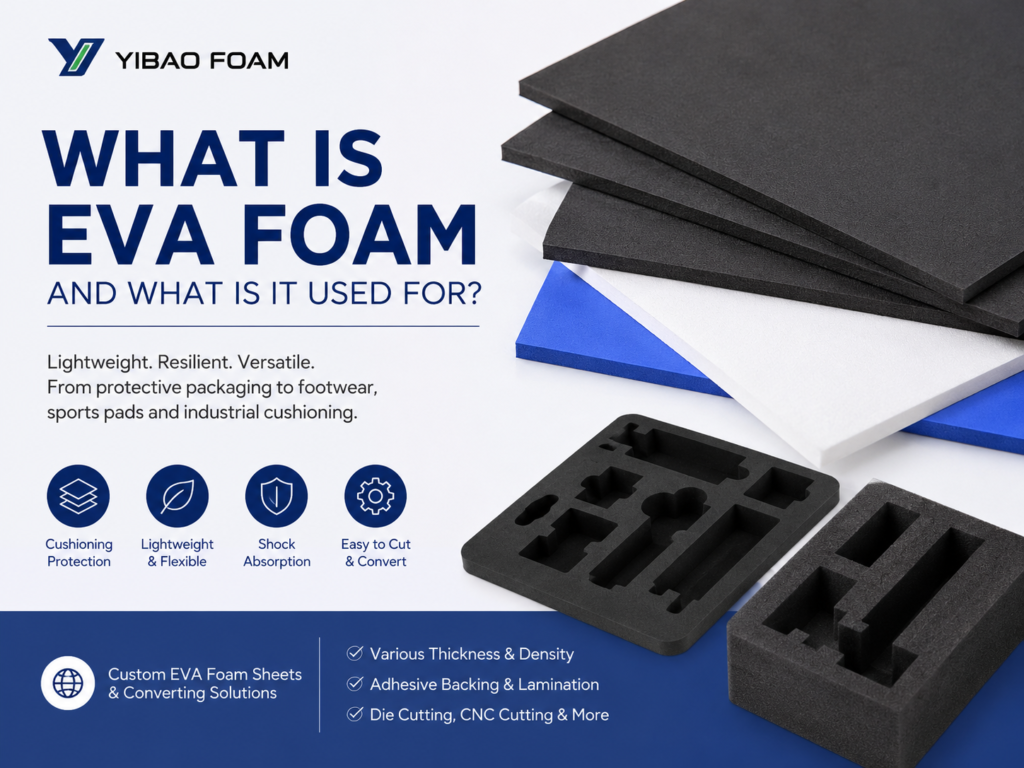
First, EVA foam is a lightweight, flexible, and resilient material used for cushioning, protection, comfort, and shaped components. It appears in packaging inserts, footwear layers, sports pads, protective cases, tool organization, and light industrial cushioning. However, a reliable project does not start with the material name alone. It starts with the right thickness, density, hardness, color, sheet format, backing, lamination, and converting method.
Therefore, this guide explains EVA material from a practical sourcing and engineering angle. It covers material benefits, common uses, suitable scenarios, PE comparison, specification details, sample review, and quote preparation. In addition, it shows how sheet selection, PE FOAM comparison, converting support, and contact paths fit into a clear B2B material selection process.
Jump to:
Material Basics Properties Applications Suitable Projects EVA vs PE Specification Samples FAQ
What EVA Material Is and Why Industrial Projects Use It
To begin with, EVA means ethylene-vinyl acetate. In sheet form, it can provide a soft, elastic, and easy-to-handle structure. It can also be cut into flat parts, shaped into inserts, laminated into layers, or backed with adhesive for assembly work.
In practical use, this material often acts as a cushion and support layer. It can reduce direct surface contact, hold parts in position, improve touch, and help protect products during movement. Moreover, it can create a cleaner presentation than loose fillers or rough packing materials.
However, EVA sheet is not one fixed product. A soft grade, a firm grade, a low-density grade, and a high-density grade can perform differently. Therefore, specification should match the application, not just the product name.
For early material review, YIBAO’s EVA category is the main starting point for related sheet materials and sample discussion. It is suitable when a project needs cushioning, inserts, pads, footwear components, or converted sheet parts.
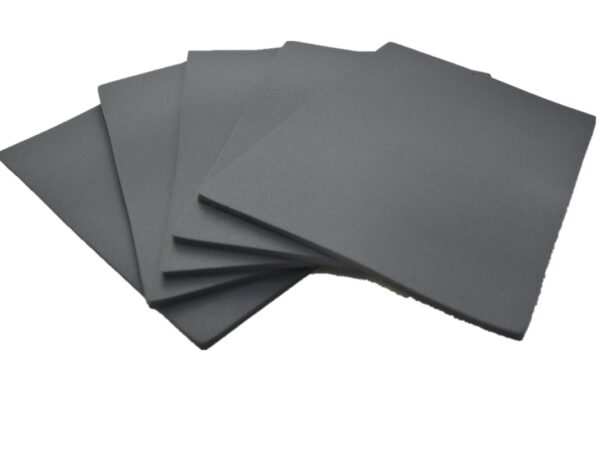
EVA sheet material can support packaging inserts, protective pads, case interiors, and light industrial cushioning.
Key Sheet Properties: Softness, Resilience, Cushioning, Color, and Density
First, softness affects the contact feel. A softer grade can suit comfort pads, footwear layers, protective surfaces, and light contact areas. However, excessive softness may reduce support when a product is heavy or when cavity walls need to stay stable.
Next, resilience affects recovery after compression. A resilient sheet can return better after pressing, packing, and repeated handling. Therefore, it is useful for reusable case interiors, sports pads, storage trays, and products that move through packing and unpacking steps.
In addition, cushioning helps reduce contact stress and minor impact risk. The final effect depends on product weight, sheet thickness, density, cavity depth, and support area. For this reason, real samples remain important when drop, vibration, or repeated pressure may occur.
Moreover, density changes the balance between light weight and support. A lower-density sheet often feels lighter and softer. A higher-density sheet often feels firmer and more stable at the edge. As a result, density should be reviewed together with thickness and part geometry.
Softness and Support Should Be Reviewed Together
For example, a thin soft sheet may work well as a surface pad. However, the same sheet may not support a heavy instrument inside a case. A firmer or thicker grade may be needed when the cavity must hold shape during transport.
At the same time, overly firm material can create pressure on delicate surfaces. Screens, lenses, painted housings, and polished covers may need softer contact zones. Therefore, the ideal grade often depends on both product weight and surface sensitivity.
Color Affects Presentation and Inspection
In many industrial projects, black and gray sheets create a clean and controlled appearance. They can support tool cases, instrument kits, electronics packaging, and sample trays. Meanwhile, white or colored sheets can support display packaging, sports goods, or color-coded organization.
However, color approval should use a physical sample. Screen photos can change shade, brightness, and contrast. In addition, dust, fingerprints, adhesive marks, and cutting marks appear differently on each color.
Edge Quality Influences Finished Part Value
Furthermore, the visible edge can affect perceived quality. A display insert, premium case, or branded sample kit needs clean cut walls. A hidden spacer or internal pad may accept a simpler edge finish.
Therefore, the cutting process should be selected early. Die cutting can fit flat repeat parts. CNC cutting can support deep pockets, stepped cavities, and thicker sheets. Lamination can also create color layers, soft-touch surfaces, or stronger visual contrast.
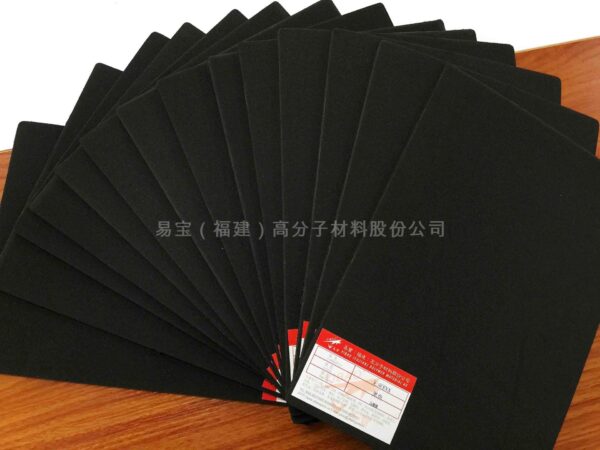
Sheet samples help compare firmness, surface feel, thickness, color, and cut edge appearance before bulk planning.
Common Uses: Packaging Inserts, Footwear, Sports Pads, Protective Cases, and Industrial Cushioning
Overall, EVA sheet material is useful because it can serve both protective and presentation functions. It can hold shape, cushion contact, reduce movement, and support clean assembly. However, each application needs a different route for thickness, density, and processing.
Packaging Inserts and Presentation Trays
First, packaging inserts help products stay organized. A shaped insert can reduce movement, separate accessories, protect surfaces, and improve unpacking. In addition, it can make a kit look more complete and easier to inspect.
However, a good insert does more than fill space. It should hold the part without excessive pressure. It should also allow easy removal through finger notches, open corners, or partial-depth cavities.
For electronics, instruments, tools, medical accessories, sample boxes, and hardware kits, cavity design matters. The insert should match product weight, surface sensitivity, case depth, and packing workflow. Therefore, drawings and physical samples can reduce redesign work.
Footwear Layers and Comfort Components
Next, footwear parts often need light weight, rebound, comfort, and shape control. EVA-based sheets can support insoles, midsoles, heel pads, arch layers, and comfort inserts. At the same time, the grade should match the required support level.
A soft sheet may feel comfortable at first touch. However, a firmer grade may provide better support over longer use. Therefore, compression recovery, wear behavior, thickness, and surface feel should be checked through actual fitting trials.
Sports Pads, Mats, and Protective Goods
Furthermore, sports products often need a balance of cushioning and stability. Training pads, kneeling pads, yoga blocks, protective guards, and grip areas can use flexible sheet structures. However, a pad that is too soft may lose support during repeated pressure.
In many cases, layered construction works better than one single sheet. A softer top layer can improve comfort. A firmer lower layer can support shape. Additionally, fabric or film lamination can improve touch, surface durability, or appearance.
Protective Cases and Tool Organization
In protective cases, material selection affects both protection and usability. A tool, gauge, camera part, test device, or precision accessory should sit securely inside the cavity. Meanwhile, the part should still be easy to remove during daily work.
Therefore, the cavity should allow proper clearance. Sharp corners, polished surfaces, and fragile details may need relief zones. A contrasting bottom layer can also make missing tools easier to notice.
Industrial Cushioning, Pads, Liners, and Spacers
Industrial cushioning often focuses on spacing, surface protection, vibration reduction, and clean assembly. Pads and liners can separate parts, protect finishes, or reduce direct contact. Moreover, adhesive backing can turn a sheet into a ready-to-apply assembly part.
However, the use environment must be reviewed. Heat, oil, outdoor exposure, chemicals, and long-term compression may require another foam family. As a result, material choice should follow the operating condition rather than only the desired touch.
Suitable Project Scenarios and When to Review Another Material
In practical selection, the most important question is not only whether the material is available. The better question is whether the material fits the real function. Therefore, the following scenario logic helps connect product use with the next sourcing step.
Generally, EVA-based sheet is a strong fit when a project needs soft contact, resilient cushioning, clean presentation, shaped pockets, or a comfortable surface. However, harsh sealing, high-temperature exposure, oily environments, or long-term outdoor compression may need other material families such as EPDM, silicone, NBR, CR, or PE.
| Project scenario | Why EVA-based sheet may fit | Selection note |
|---|---|---|
| Tool case inserts | Clean cavities, stable support, neat product layout | Check cavity depth, finger access, wall stability, and color contrast. |
| Electronics packaging | Soft contact, organized layout, improved presentation | Review surface marks, dust visibility, product weight, and removal clearance. |
| Footwear comfort layers | Light weight, rebound, comfort, shape control | Test compression recovery, thickness, and long-use comfort. |
| Sports pads and mats | Cushioning, soft feel, flexible structure | Balance softness with support under repeated pressure. |
| Assembly pads and spacers | Controlled contact, gap filling, optional adhesive backing | Test adhesion on the real surface before volume production. |
| Harsh sealing or high heat | May not be the first option | Review EPDM, silicone, CR, NBR, or other specialty materials. |

Firmer sheet grades can support case inserts, protective pads, industrial cushioning, and shaped parts.
EVA Material vs PE Material: Quick Selection Comparison
In many packaging and cushioning projects, PE material enters the same discussion. Both material families can support protection, cushioning, cutting, and sheet conversion. However, they often feel and behave differently in finished parts.
Generally, EVA-based sheet is often selected when touch, resilience, presentation, and shaped insert appearance matter. PE-based sheet often works well for broader protective packaging, spacers, insulation layers, and economical transport cushioning. Still, grade-to-grade differences can be large, so sample testing remains the safest route.
| Selection factor | EVA-based sheet | PE-based sheet | Practical thought |
|---|---|---|---|
| Hand feel | Often softer and more elastic | Often lighter and more rigid in many grades | Comfort and presentation often favor EVA-based grades. |
| Cavity design | Can support clean cutouts and stable walls | Can support blocks, spacers, and liners | Visible inserts need stronger edge review. |
| Cushioning style | Good resilience in many sheet grades | Good for broad transport protection | Product weight and drop risk should guide testing. |
| Appearance | Often chosen for cleaner presentation | Often chosen for functional packing layers | Display packaging needs surface approval. |
| Processing | Die cutting, CNC cutting, backing, lamination | Slicing, die cutting, lamination, backing | Part shape and order volume guide the method. |
| Typical fit | Cases, pads, sports goods, footwear, inserts | Packaging blocks, spacers, insulation, liners | Application testing should decide the final route. |
In short, EVA-based material can be the better fit when appearance, touch, shaped pockets, and resilient feel matter. PE material can be a practical choice when the project needs broader protective packing or simpler spacer structures. Nevertheless, the same drawing should be tested in both materials when the selection is unclear.
In addition, some designs use a material combination. A firm base can support weight, while a softer top layer protects the surface. Similarly, a laminated color layer can improve visual control in tool organization or missing-part checks.
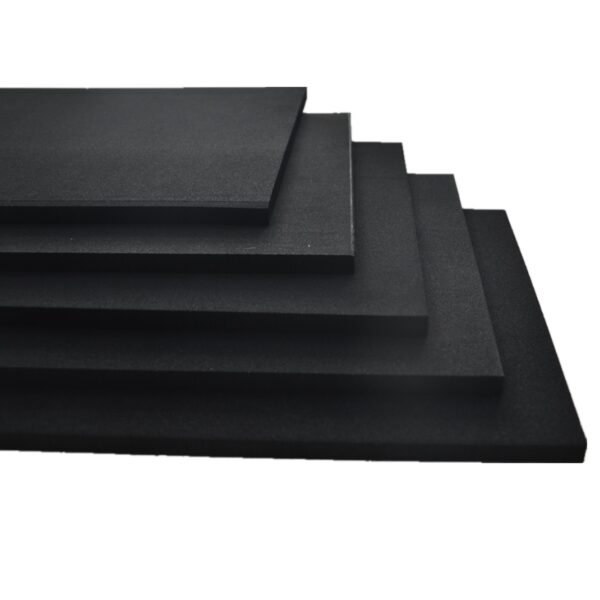
PE sheet can be reviewed alongside EVA-based material when packaging, cushioning, spacer, and liner requirements overlap.
How to Specify Thickness, Density, Color, Sheet Size, Adhesive Backing, Lamination, and Cutting
Clear specifications help reduce sample errors. They also help the factory suggest a realistic processing route. Therefore, the inquiry should describe both the material target and the final part function.
Thickness
First, thickness affects cushioning depth, cavity support, cost, and cutting method. Thin sheets can work as pads, liners, gaskets, strips, and adhesive-backed parts. Thicker sheets can support deeper inserts, case interiors, sports mats, and block cushioning.
However, thicker sheets may need CNC cutting, splitting, or lamination. A simple die-cut process may not create deep pockets or stepped cavities. Therefore, part thickness should be checked together with processing method.
Density and Hardness
Next, density and hardness shape the final feel. A lighter grade may reduce weight and improve softness. A firmer grade may support product weight and improve edge stability.
At the same time, density alone cannot describe every behavior. Compression recovery, edge quality, surface feel, and shape retention still need sample review. As a result, a sample set with several nearby grades is often useful.
Color and Surface Finish
Additionally, color affects both appearance and inspection. Black can create a professional case interior. Gray can reduce strong contrast. White can support a clean display, although marks may appear more easily.
For color-sensitive projects, physical swatches should guide approval. Photos can help early discussion, but they cannot confirm exact shade. Therefore, final color selection should use real material under normal lighting.
Sheet Size, Roll Format, and Yield
Moreover, sheet size affects cutting yield and waste. A larger sheet may suit big inserts or long strips. A smaller sheet may simplify storage and handling for smaller pads.
If roll material is needed, roll width, length, thickness tolerance, and winding behavior should be reviewed. If block or plank material is needed, slicing tolerance becomes important. Consequently, sheet format should match the production process, not only the drawing size.
Adhesive Backing
In many assemblies, adhesive backing turns a sheet into a ready-to-apply component. Pads, spacers, strips, liners, vibration layers, and protective contact parts can use pressure-sensitive adhesive. However, adhesive selection depends on the bonding surface.
Metal, plastic, painted surfaces, powder-coated surfaces, and fabric can require different adhesive systems. In addition, temperature, pressure, surface cleanliness, and aging time can change performance. Therefore, adhesive samples should be tested on the real substrate.
Lamination and Layered Construction
Besides backing, lamination can improve function or appearance. A fabric layer can improve hand feel. A film layer can support a cleaner surface. A color layer can improve visual control for missing tools or display design.
However, lamination must remain stable during cutting and use. Poor bonding can lift at the edge, move during handling, or wrinkle after storage. Therefore, laminated samples should be checked for edge separation, surface flatness, and dimensional stability.
Die Cutting, CNC Cutting, and Finishing
Finally, cutting method should follow the part shape. Die cutting often suits simple flat parts, strips, pads, gaskets, and repeat shapes. CNC cutting often suits thick sheets, shaped pockets, layered inserts, and lower-volume sample parts.
For converted parts, YIBAO’s foam converting support can connect sheet choice with finished shape. This is useful when the project needs slicing, adhesive backing, lamination, die cutting, CNC cutting, or insert samples.

Converting support can connect sheet selection with adhesive backing, lamination, die cutting, CNC cutting, and shaped insert production.
When to Request Samples and a Custom Converting Quote
In general, samples should be requested before the project depends on exact feel, fit, color, adhesive behavior, or edge quality. A material description can support early screening. However, a physical sample shows compression, surface finish, thickness, and recovery more clearly.
For packaging inserts, sample review becomes important when the product is fragile, heavy, expensive, or irregular in shape. The insert must hold the part without causing pressure marks. In addition, it must fit the real box, carton, or protective case.
For sports pads and footwear components, samples should test comfort, bending, recovery, and thickness. A sheet that feels comfortable by hand may behave differently under body pressure. Therefore, practical use testing should support approval.
For adhesive parts, samples should be applied to the real surface. The surface material, coating, temperature, pressure, and assembly method can change bonding. As a result, adhesive-backed foam parts should always be tested under actual conditions.
Information to Prepare Before a Quote
First, the application should be described clearly. Packaging insert, protective case, sports pad, footwear part, liner, spacer, gasket, or cushioning pad all lead to different material choices. In addition, the use environment should be included when heat, oil, outdoor exposure, or long compression may appear.
Next, dimensions should be prepared. Thickness, sheet size, part size, cavity depth, tolerance needs, and edge requirements can improve quote accuracy. If drawings exist, PDF, DXF, CAD, or STEP files can make the review faster.
Moreover, product weight and contact surface should be shared for insert projects. A heavier part may need stronger support. A delicate surface may need softer contact or extra clearance. Therefore, product photos with dimensions can be very helpful.
Finally, quantity and timeline should be included. A prototype batch may use CNC cutting. A repeat order may use tooling or die cutting. Therefore, volume information helps match cost, speed, and process route.
| Quote detail | Why it matters | Useful format |
|---|---|---|
| Application | It guides grade selection and process planning. | Packaging, footwear, sports pad, liner, spacer, case insert |
| Thickness and density | They affect support, recovery, feel, and cost. | Millimeters, density range, hardness target, sample reference |
| Color and finish | They affect appearance and inspection. | Black, gray, white, custom color, swatch reference |
| Drawing or dimensions | They improve fit and quotation accuracy. | PDF, DXF, CAD, STEP, measured photos |
| Processing method | It affects edge quality, tooling, and lead time. | Die cutting, CNC cutting, slicing, backing, lamination |
| Quantity and timeline | They influence process route and cost. | Prototype, trial batch, monthly volume, delivery target |
Practical Selection Process for Packaging, Pads, and Inserts
A practical material decision should follow the product function. For protective packaging, the first question is whether the insert must hold, cushion, display, separate, or improve unpacking. Then, product weight, fragility, and surface sensitivity should guide thickness and density.
For tool organization, cavity stability is usually important. A firmer grade can help keep walls upright. Meanwhile, finger access and corner relief help remove tools without tearing the insert or slowing work.
For electronics packaging, surface safety and clean presentation matter. Screens, lenses, painted housings, and polished covers should avoid rough contact. Therefore, sample compression should check whether the material leaves marks after storage.
For footwear parts, comfort and rebound guide the decision. Thickness should fit the shoe structure. Density should match support expectations. In addition, wear testing should confirm long-term behavior.
For sports products, soft contact and stable support should be balanced. A mat or kneeling pad may need a thicker base. A wearable pad may need more flexibility. Therefore, bending and pressure testing should guide the final grade.
For industrial pads and liners, the environment should come first. Heat, oil, chemicals, UV exposure, and long compression can change the material choice. In these cases, the project may need review across other foam families before final approval.
How EVA Sheets Work with Packaging Design
In packaging, the insert is part of the product experience. A clean tray can make a kit look organized and easy to understand. It can also reduce rattling, surface contact, and movement during transportation.
First, the layout should follow product priority. Heavy parts need stable support. Fragile parts need soft contact and clearance. Frequently removed parts need finger access, while small accessories need visible positions.
Next, the cavity should allow practical handling. A part that fits perfectly in a drawing may still be hard to remove. Therefore, prototype review should include actual packing, closing, shaking, and unpacking steps.
Moreover, packaging can be single-use or reusable. A reusable case needs stronger cavity walls and better recovery. A one-way shipment may focus more on economical protection. Consequently, the same product may need different inserts for different sales channels or service routes.
How EVA Sheets Work with Pads, Liners, and Assembly Parts
Beyond packaging, EVA-based sheets can become functional pads, liners, strips, and spacers. These parts can reduce contact marks, fill gaps, protect finishes, and improve touch. In addition, they can simplify assembly when supplied with adhesive backing.
For surface protection, softness and finish matter. The material should not scratch or mark the protected part. It should also avoid excessive pressure on delicate details.
For spacers and gap fillers, compression behavior becomes more important. A part that compresses too easily may lose spacing function. A part that is too firm may transfer unwanted pressure.
For adhesive pads, part shape can improve assembly. Rounded corners reduce lifting risk. Release liner tabs can improve handling speed. Moreover, larger bonding areas can help maintain adhesion on suitable surfaces.
Testing and Approval Thinking Before Production
Before production, material approval should include more than a visual check. Thickness, density, compression feel, surface marks, cut edge quality, bonding behavior, and part fit should all be reviewed. In addition, the sample should be tested in the real package, case, assembly, or product structure.
For engineering records, cellular material discussions may refer to recognized testing methods where suitable, such as ASTM D1056 for flexible cellular sponge or expanded rubber material classification. However, a standard reference should not replace project-specific sample testing, and it should not be treated as a certification unless confirmed for the selected material and requirement.
Furthermore, packaging and insert tests should include the real product weight. A sample may look neat when empty, yet perform differently after loading. Therefore, fit, removal, lid pressure, surface marks, and shipping movement should be checked together.
For adhesive-backed parts, the real bonding surface is essential. Painted metal, bare metal, ABS, PP, PC, powder-coated surfaces, and fabric can behave differently. As a result, an adhesive trial should include surface cleaning, application pressure, dwell time, and expected temperature range.
Common Material Selection Mistakes
One common mistake is choosing thickness without checking density. A thick soft sheet may compress too much. Meanwhile, a thinner but firmer sheet may support the product better.
Another mistake is approving a material from a photo only. Photos can hide texture, firmness, edge quality, and color difference. Therefore, physical samples should support final approval.
A third mistake is ignoring removal access in insert design. A tight cavity can hold the product, yet it may slow daily use. For this reason, relief cuts and finger notches should be part of the drawing discussion.
A fourth mistake is assuming every black sheet is the same. Different grades may vary in density, hardness, cell structure, odor, edge quality, and recovery. As a result, the approved sample should be tied to a clear production reference.
Finally, process planning should not be delayed. A design may look simple but require lamination, CNC cutting, adhesive backing, or tooling. Therefore, converting review should begin before the design is locked.
Sample Review Checklist
Before approving a sample, several checks should be completed. First, the surface should be reviewed under normal light and strong light. Small scratches, dust visibility, pinholes, or uneven shade can affect the finished part.
Next, thickness should be measured at several points. Variation can affect cavity fit, stacking, and adhesive assembly. In addition, cut edge quality should match the product level.
After that, the real product should be placed into the sample cavity. The part should sit securely without strong pressure. It should also lift out smoothly during normal handling.
Finally, the sample should be tested inside the real box or case. The lid should close correctly. The product should not rattle excessively. Therefore, a practical fit test can reveal issues before bulk production.
Useful Information for a First Inquiry
- Application: insert, pad, liner, spacer, footwear part, sports pad, or industrial cushion.
- Material target: soft, firm, lightweight, resilient, adhesive-backed, laminated, or clean-cut.
- Thickness: target millimeters and tolerance needs.
- Color: black, gray, white, custom color, or approved swatch.
- Drawing: PDF, DXF, CAD, STEP, or measured photos.
- Processing: slicing, die cutting, CNC cutting, lamination, adhesive backing, or multilayer assembly.
- Quantity: prototype, trial order, repeat batch, or monthly demand.
FAQ
Is EVA material closed cell?
Generally, EVA-based sheet belongs to the closed-cell material family. That means many small cells inside the material are sealed. As a result, the sheet can provide cushioning, light moisture resistance, and stable handling in many normal applications. However, exact behavior depends on grade, thickness, density, surface, and processing.
Is EVA material waterproof?
Closed-cell EVA-based sheet can resist light water exposure better than many open-cell materials. However, finished-part waterproof performance should not be assumed. Cut edges, holes, adhesive layers, lamination, seams, and long soaking conditions can change the result. Therefore, real-use testing should confirm performance.
Can EVA-based sheet be die cut or CNC cut?
Yes, many grades can be die cut, CNC cut, sliced, laminated, or supplied with adhesive backing. Die cutting often suits repeated flat shapes and volume work. CNC cutting often suits thicker sheets, stepped cavities, and shaped inserts. However, thickness, edge quality, tolerance, and quantity should guide the final process.
What information should be sent for a quote?
A clear request should include application, thickness, density or hardness target, color, sheet size, part dimensions, drawing, processing method, adhesive or lamination need, quantity, and use environment. In addition, product photos and package photos can help the material team understand the real design problem.
When should samples be requested?
Samples should be requested when fit, feel, color, edge quality, cushioning, adhesive behavior, or compression recovery matters. In most new projects, sample review should happen before tooling or bulk cutting. This step helps confirm the material, the drawing, and the converting route.
Conclusion: Build the Specification Around the Real Use
In summary, the best material decision starts with the application. A packaging insert needs fit and protection. A footwear layer needs comfort and rebound. A sports pad needs stable cushioning. An industrial liner needs controlled contact and suitable environmental behavior.
Therefore, specification should include thickness, density, hardness, color, sheet format, adhesive backing, lamination, cutting method, quantity, and sample requirements. This approach makes EVA foam selection more practical and reduces the risk of mismatched parts during production.
For a smoother project start, use these three actions:
- First, define the function clearly: cushioning, display, spacing, comfort, protection, or organized storage.
- Next, prepare drawings, photos, dimensions, product weight, color target, and processing needs.
- Finally, request samples before bulk production when fit, hand feel, edge quality, or adhesive performance matters.
Request Sheet Samples or Send Drawings for Custom Inserts
For EVA sheet samples, shaped inserts, adhesive-backed pads, laminated layers, or CNC and die-cut parts, YIBAO can review the application, material target, drawing, quantity, and converting route. Moreover, related PE FOAM and converting options can be checked when the project needs a broader material comparison.