
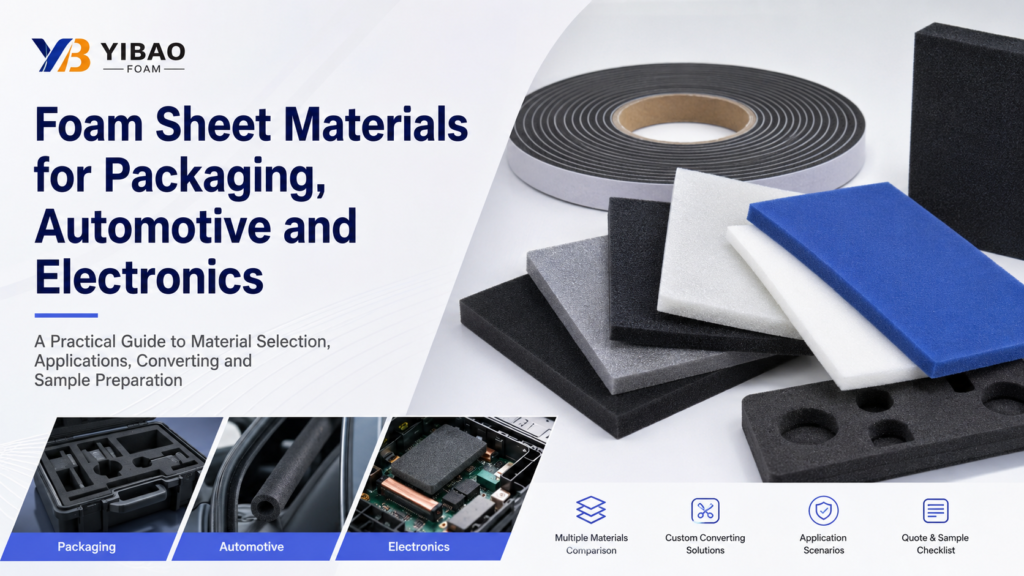
A foam sheet material guide is useful only when it helps a buyer move from a broad material name to a workable part. Packaging teams may need impact protection and clean cavities. Automotive programs may need sealing, recovery and anti-rattle control. Electronics assemblies may need thin pads, stable thickness, low debris and adhesive-backed placement.
This guide compares foam sheet materials by job, environment and converting route. It covers EVA, PE, EPDM, neoprene-related rubber foam, silicone and NBR/PVC without treating one family as the universal answer.
Foam Sheet Material Guide: Start with the Job, Not the Material Name
A material shortlist becomes faster when the project team defines the part in practical terms. “Black foam, 3 mm” is not enough. “Adhesive-backed anti-rattle pad between an ABS cover and a painted metal bracket” gives the supplier information that can influence material family, compression, adhesive, liner and cutting method.
Begin with four decisions:
These decisions prevent two common sourcing errors. The first is choosing by hand feel alone. A soft sample may bottom out under a heavy product, while a firm sample may transfer too much pressure to a display or housing. The second is approving a flat square sample before checking the final geometry. Narrow walls, small holes, deep cavities and adhesive-backed shapes can behave differently after converting.
The most efficient path is to identify two or three likely material families, request converted samples in the intended thickness, and test them inside the real package or assembly.
Compare EVA, PE, EPDM, Neoprene, Silicone and NBR/PVC by Use
The cards below are a starting map rather than a substitute for grade-specific data and sample testing. Each material family can vary by density, cell structure, hardness, surface, color and formulation.
EVA Foam
Useful when: a project needs shaped cavities, firmer support, visible color options or clean converted parts.
Typical direction: tool-case inserts, presentation packaging, protective pads, footwear and sports components.
Explore EVA foam sheet optionsPE Foam
Useful when: lightweight closed-cell cushioning, separation, insulation or moisture-resistant direction matters.
Typical direction: carton liners, edge protectors, transport pads, equipment packaging and industrial spacers.
Explore PE foam sheet optionsEPDM Foam
Useful when: sealing, weather exposure, ozone resistance direction and compression recovery are priorities.
Typical direction: automotive seals, outdoor enclosures, appliance gaskets, door pads and weather strips.
Explore EPDM foam materialsNeoprene, SBR, SCR and CR
Useful when: rubber-like flexibility, cushioning, fabric lamination or resilient soft-contact performance is needed.
Typical direction: sleeves, bags, protective gear, sports supports, anti-rattle pads and industrial liners.
Explore neoprene-related foamSilicone Foam
Useful when: temperature-sensitive sealing, soft compression or electrical and appliance applications require silicone grades.
Typical direction: electronics pads, equipment gaskets, appliance seals and heat-adjacent cushioning.
Explore silicone foam materialsNBR/PVC Foam
Useful when: oil-contact direction, insulation and flexible industrial cushioning need early review.
Typical direction: machinery pads, pipe insulation, maintenance parts and selected gasket applications.
Explore NBR/PVC foamHow Thickness, Density, Hardness and Compression Change the Result
Material family alone does not define performance. Two EVA sheets can feel and cut differently, and two EPDM grades can recover differently after compression. A useful specification discussion connects each number to the finished part.
Thickness
Controls available cushioning distance, cavity depth and assembly pressure. Include adhesive or lamination in the finished thickness check.
Density
Influences support and handling, but a higher value is not automatically better. Heavy loads and delicate surfaces may need different responses.
Hardness
Useful for comparing some EVA and rubber-foam grades, yet it cannot replace a compression test in the final gap.
Compression recovery
Important for seals, repeated-use inserts and anti-rattle pads that must continue filling a gap after extended pressure.
For packaging, test thickness and density with the real product weight. A thick low-density pad may compress more than expected, while a thinner firmer pad may transmit shock. For a case insert, also check whether thin cavity walls stay upright after repeated removal.
For a seal, define the free thickness, installed gap and target compression rather than requesting “soft EPDM.” This gives the supplier a basis for selecting cell structure and recovery. For an electronics pad, include the allowable closure force and any tolerance stack around the housing.
Who this approach suits
It is especially useful for OEM sourcing teams comparing several materials, engineers moving from a prototype to a drawing-controlled part, packaging designers balancing protection and presentation, and production teams that need adhesive-backed or liner-mounted components ready for assembly.
Packaging Foam: Choose by Load, Surface Risk and Reuse
Packaging selection should begin with the product, not the empty box. Record the product weight, fragile zones, support points, transport risk and how the user removes the item. A cavity can look neat in a photo and still fail if it grips a polished surface, leaves a connector unsupported or allows a heavy component to compress the base.
When EVA is the stronger starting point
EVA often makes sense for organized inserts with defined cavities, visible presentation and repeated handling. Tool cases, sample kits and instrument trays may need firm cavity walls, finger notches and layered construction. Density should be selected with the product load and removal force in mind; a firmer grade is not automatically safer for a delicate surface.
When PE is the stronger starting point
PE is often considered for lightweight protective layers, separators, carton liners and edge protection. It can be useful when a package needs closed-cell cushioning direction without the visual structure of a presentation insert. The sample should still be checked for compression under load, rubbing against sensitive finishes and recovery after repeated packing cycles.
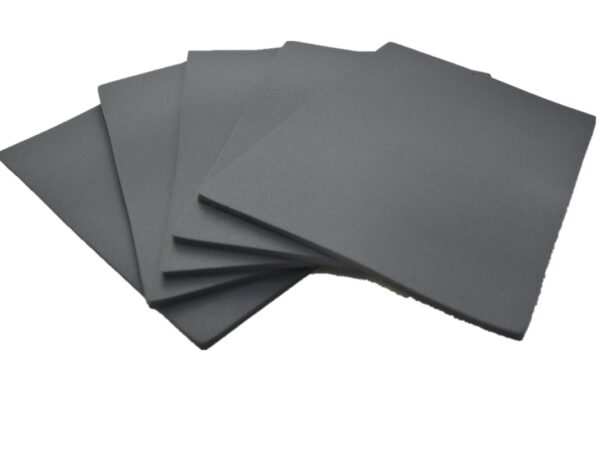
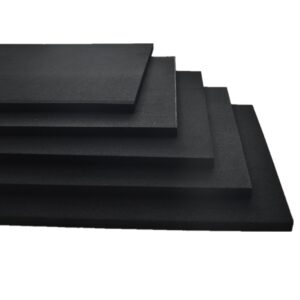
Packaging sample checks
- Load the real product and check whether the base bottoms out or the cavity walls bend.
- Check finger access, removal force and contact with screens, coatings, glass and polished metal.
- Repeat the loading and removal cycle to see whether fit changes after use.
- Review final carton movement, stacking pressure and the way converted parts are packed before shipment.
Automotive Foam: Separate Sealing, NVH and Interior Contact
Automotive projects often fail when several jobs are grouped under one vague requirement such as “reduce noise.” A housing gasket, a door weather strip and a small anti-rattle pad may all be foam parts, but they face different compression, exposure and bonding conditions.
Seals and gasket frames
For weather-facing seals, EPDM is commonly reviewed because suitable grades can support outdoor exposure, ozone-resistance direction and controlled compression. The sample should match the real gap and fastener pressure. Too little compression can leave a leak path; too much can raise assembly force or create long-term deformation.
Anti-rattle and NVH pads
For squeak and rattle control, the key question is what movement occurs between the two surfaces. A soft pad can take up a small clearance, while a firmer EVA, PE, CR or rubber-foam construction may support a heavier panel. Adhesive selection must consider surface energy, dust, oil, installation pressure and temperature rather than being added after the foam is approved.
Heat, odor and enclosed spaces
Heat-adjacent locations may move silicone into the shortlist, while oil-contact zones may require NBR/PVC direction. Interior applications can also raise odor, fogging or cleanliness requirements. These requirements should be stated in the inquiry so the discussion stays grade-specific instead of relying on a broad material label.
Electronics Foam: Control Thickness, Debris and Placement
Electronics assemblies usually have less room for correction. A pad may sit below a display, around a speaker, beside a battery module or under a housing cover. Small changes in thickness can alter pressure, alignment and closure force.
Match compression to the available gap
A useful drawing should show the free gap and the compressed condition, not only the pad thickness. A display support pad may need stable thickness; a dust seal may need softer compression; a spacer near a screw boss may need firmer support. EVA, PE, EPDM and silicone can all appear, but the location determines the shortlist.
Review cleanliness and converted edge quality
Small die-cut parts can create assembly problems when edges tear, dust is released or liners do not peel consistently. A converted sample should be tested on the production surface with the intended operator sequence. Kiss-cut parts on a release liner can improve picking and placement, but only when cut depth, adhesive coverage and liner release are stable.
Do not generalize temperature or flame claims
Silicone is often considered for temperature-sensitive sealing and cushioning, but the required continuous temperature, peak exposure and test standard must be confirmed for the exact grade. The same rule applies to flame-retardant, anti-static and insulation claims: specify the target requirement before selecting the material.
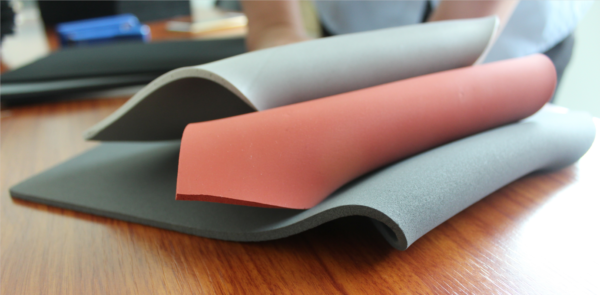
Choose the Converting Route Before the Material Is Fully Approved
A flat material sample does not show the full production risk. Slitting, lamination, adhesive backing, die cutting, kiss cutting and CNC cutting can change flatness, edge quality, tolerance and handling. Material and process should therefore be reviewed together.
Die cutting
Suitable for repeat pads, strips, washers, frames and stable two-dimensional shapes. Thin bridges and sharp internal corners need review.
Kiss cutting
Useful for small adhesive-backed parts kept on a liner. Cut depth, liner strength and peel behavior affect line handling.
CNC cutting
Useful for prototypes, deeper cavities and complex insert layouts. Tool path and minimum corner radius can limit detail.
Lamination and adhesive
Useful for layered inserts, textile-backed foam and assembly-ready parts. Bonding surface, dwell time and temperature must be stated.
Drawings should identify function-critical dimensions, thickness tolerance, material orientation, adhesive side and packing direction. Foam can compress during cutting and packing, so unrealistic tolerances may raise cost without improving the finished assembly.
For a project that already has a drawing or target part shape, review YIBAO’s custom foam converting options before requesting a final production quote.
What to Send for a Useful Quote and Sample
A useful inquiry gives the supplier enough context to recommend a material direction without guessing. Send a drawing when available, but do not wait for a perfect file if the project is still at concept stage. Product photos, assembly photos and a marked-up sketch can establish the first sample path.
Quote checklist
- Part function: cushioning, sealing, spacing, insulation, anti-rattle control, surface protection or presentation.
- Application: packaging, automotive, electronics, appliance, industrial equipment or another use scene.
- Dimensions: length, width, thickness, cavity depth, holes, critical tolerance and expected compressed gap.
- Environment: indoor or outdoor use, temperature, humidity, sunlight, oil, dust, cleaning agents or repeated opening.
- Surface and assembly: contact material, adhesive need, release liner, lamination, installation pressure and operator sequence.
- Production information: sample quantity, expected order volume, packing method and whether the design is fixed or still changing.
- Required evidence: target test standard, report, color approval, dimensional report or packaging validation.
Approve the converted sample, not only the raw sheet
The final sample review should reproduce the intended thickness, adhesive, liner, cut shape and packing method. Check fit after installation, not only on the workbench. For packaging, inspect product movement and removal. For automotive, inspect compression, edge lift and recovery. For electronics, inspect placement, residue, debris and closure force.
When export packaging risk is high, the test plan may refer to a recognized distribution-testing framework such as ASTM D4169. The actual assurance level, distribution cycle and acceptance criteria should be selected for the shipment and product rather than copied from another project.
A pilot or repeat sample should also confirm labeling, stacking, bagging and carton protection so that a good prototype does not arrive deformed or mixed during production.
Foam Sheet Material FAQ
Which foam sheet is best for protective packaging?
EVA and PE are common starting points, but the better choice depends on product weight, surface sensitivity, required cavity shape, available package space and reuse. Test the final converted insert with the real product rather than selecting by softness alone.
When should EPDM be considered for an automotive part?
EPDM is commonly considered for weather-facing seals, gasket frames, pads and strips where outdoor exposure and compression recovery matter. The exact grade still needs to match the gap, pressure, adhesive, temperature and any odor or test requirements.
Is silicone foam always the best option near heat?
No. Silicone may be a strong candidate, but the required continuous temperature, peak exposure, compression and certification must be checked against the exact grade. Cost, adhesive compatibility and cut-part behavior also matter.
Should density or thickness be selected first?
They should be evaluated together. Thickness controls available cushioning or compression distance, while density and structure influence support and recovery. The correct pair depends on the real load, gap and final part shape.
What is the difference between a sheet sample and a converted sample?
A sheet sample helps compare touch, thickness and basic compression. A converted sample includes the intended cut shape, adhesive, liner, lamination and packing format, so it gives better evidence for assembly and production approval.
Turn the Material Shortlist into a Working Sample
Send the application, dimensions, working environment, expected compression, adhesive requirement, drawing and sample quantity. YIBAO Foam can review the likely material family and a practical converting route for packaging, automotive, electronics or industrial parts.
Browse Foam Materials Review Converting Options Send Project Details