
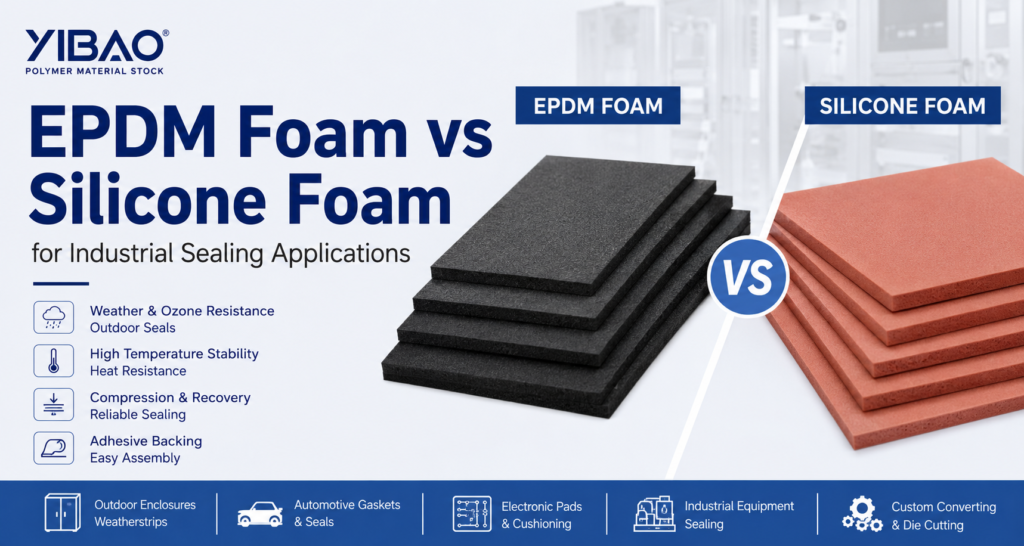
For industrial sealing, EPDM foam and silicone foam are often compared when a gasket must handle compression, dust control, outdoor exposure, vibration, heat, and assembly pressure. However, the stronger material depends on the working environment, gap design, adhesive backing, temperature range, and converting method.
This guide is written for engineering, sourcing, product development, and production teams comparing gasket materials for outdoor cabinets, electronic housings, automotive parts, HVAC equipment, appliance seals, and industrial machinery covers.
Why EPDM and Silicone Materials Are Compared for Sealing Projects
First, both material families can compress and recover after load. They help fill uneven gaps between metal, plastic, glass, painted panels, and equipment housings. As a result, both appear in gaskets, weatherstrips, cushion pads, access cover seals, and vibration-control parts.
However, the comparison should not stop at the material name. A seal must work inside a real assembly. For example, an outdoor enclosure gasket faces sunlight, ozone, rain, dust, and seasonal movement. Meanwhile, an electronic equipment pad may face tighter space, higher heat, and lower closing force.
Therefore, sealing selection should begin with function. A gasket may need to block dust, reduce air leakage, slow water splash, cushion a cover, isolate vibration, or reduce panel noise. Each function changes the best material direction.
In addition, industrial sealing projects often require processing after material selection. Sheets may need slitting, die cutting, adhesive lamination, kiss cutting, roll supply, or special packaging. Because of this, the selected material must match both the working environment and the production method.
Selection Logic Before Choosing a Gasket Material
Before comparing material routes, the project should define the gap, pressure, surface, working temperature, and exposure pattern. Otherwise, a gasket can look correct during sampling but fail during installation. In practice, the right polymer with the wrong thickness can still leak, wrinkle, or lose sealing pressure.
For this reason, the better question is not which material is universally better. Instead, the better question is which material keeps the required seal under the expected compression, temperature, and exposure conditions. This change makes material selection more practical.
Define the sealing function
First, the sealing function should be clear. A dust seal does not require the same contact force as a water splash seal. Likewise, a vibration pad does not behave like a narrow door gasket. Therefore, material density and part geometry should match the real task.
For example, a weatherstrip around a metal enclosure may need soft compression and strong recovery. At the same time, a pad under a cover plate may need more stable support. In another case, a thermal area near electronics may require a material that stays flexible after repeated heating.
Check the compression range
Second, compression range controls sealing performance. A gasket usually needs enough compression to close the gap. However, excessive compression may crush the cell structure, make installation difficult, or cause permanent deformation.
Moreover, tolerance stack-up should be considered early. A cover, hinge, screw boss, molded plastic shell, and metal frame can each add small dimensional variation. When these tolerances combine, the gasket must still maintain contact without excessive closing force.
EPDM-Based Cellular Rubber Strengths: Weather, Ozone, Outdoor Seals, and Automotive Gaskets
EPDM-based cellular rubber is widely used in outdoor sealing, automotive gaskets, appliance seals, HVAC pads, building joints, and general industrial weatherstrips. Its value comes from weather resistance, ozone resistance, aging resistance, and practical cost direction for many volume sealing programs.
In outdoor enclosures, this material can help maintain a flexible contact line around doors, access panels, utility covers, and equipment housings. It also supports dust control and splash resistance when the gasket profile, compression level, and surface finish are suitable.
For transportation parts, EPDM-based sponge materials often appear in lamp seals, mirror pads, trunk seals, door gaskets, and anti-vibration interfaces. These parts need a balance between softness, aging resistance, processing stability, and production efficiency. Therefore, this material route remains a strong candidate for weather-related sealing systems.
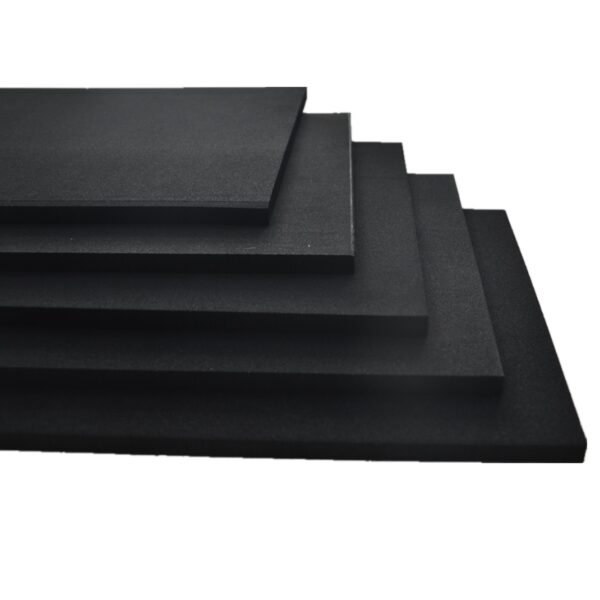
Best-fit sealing scenarios
First, this material route suits many weather-exposed sealing positions. Outdoor cabinets, vehicle parts, building interfaces, HVAC covers, and equipment access panels can benefit from its weathering profile. As a result, it fits projects where sunlight, ozone, air aging, and moisture are important concerns.
Second, it offers useful compression behavior for strip gaskets and door seals. With suitable thickness and density, it can fill gaps without creating excessive closing force. Therefore, it supports stable contact and repeatable assembly.
Finally, it can be converted into sheets, rolls, strips, die-cut gaskets, adhesive-backed pads, and laminated parts. This flexibility matters because industrial production often requires clean edges, consistent width, and reliable liner handling.
Silicone-Based Cellular Rubber Strengths: High Temperature, Electronics, and Demanding Seals
Silicone-based cellular rubber is often selected when high temperature, flexibility retention, clean appearance, and stable compression behavior matter. It can support electronic pads, lighting gaskets, thermal equipment interfaces, power-related enclosures, and industrial machinery covers.
Unlike many general-purpose sponge materials, silicone-based cellular rubber can remain flexible across wider temperature changes. This matters when a gasket must keep contact pressure after repeated heating and cooling. As a result, it is often considered for LED lighting, control cabinets, sensors, power modules, heaters, and hot-area equipment covers.
Moreover, this material route often provides soft compression and smooth rebound. It can compress against delicate housings or slightly uneven surfaces. In some designs, this reduces assembly stress while still helping the gasket fill the gap.
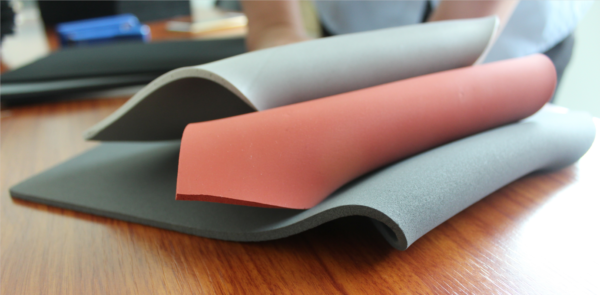
Best-fit sealing scenarios
First, this material route fits applications near electronics, lighting engines, machinery panels, and industrial equipment with elevated temperature. Therefore, it becomes useful when thermal stability is more important than the lowest material cost.
Second, it can support refined industrial designs. Electronic housings, instrument panels, sensor covers, display assemblies, and power modules often need controlled gasket behavior. Therefore, silicone-based materials can support demanding sealing programs with tighter application requirements.
However, this direction often has a higher cost level than EPDM-based options. Because of this, it should be selected for a clear performance reason, such as heat, thermal cycling, lower closing force, or sensitive assembly pressure.
Comparison Table: Temperature, Weather, Compression, Flexibility, Cost Direction, and Use Cases
The table below gives a practical selection view. However, it should not replace sample testing. Each final gasket should be confirmed with real thickness, actual compression, installation surface, adhesive system, and working environment.
| Selection Factor | EPDM-Based Cellular Rubber | Silicone-Based Cellular Rubber | Selection Note |
|---|---|---|---|
| Outdoor weather exposure | Strong fit for many outdoor sealing parts | Good in many cases, but often selected for heat or precision reasons | Use EPDM-based options for common outdoor cabinets, vehicle trims, and weatherstrips. |
| High-temperature sealing | Suitable only within grade limits | Often stronger for demanding heat zones | Move toward silicone-based material when heat is the main risk. |
| Compression behavior | Good for weatherstrips, door seals, and general gaskets | Useful for softer, more precise, or heat-related assemblies | Match thickness and density to the actual closing force. |
| Adhesive backing | Available with suitable tape and surface preparation | Available with suitable tape selection for heat or assembly needs | Test peel and compression behavior on the real substrate. |
| Cost direction | Often more economical for volume sealing | Often higher cost with stronger heat capability | Compare finished-part value, not only raw sheet price. |
| Common applications | Weatherstrip, automotive gasket, HVAC seal, building seal | Electronic pad, LED gasket, hot-area seal, precision equipment gasket | Select by environment, compression demand, and converting route. |
Application Examples for Industrial Sealing Projects
Industrial sealing decisions become clearer when the material is matched to the real part. Therefore, the following examples focus on function, environment, and processing route.
Weatherstrip and outdoor enclosure gasket
First, weatherstrip design often starts with a door, cover, or access panel. The gasket must compress when closed and recover when opened. Therefore, it needs softness, rebound, and long-term aging resistance.
EPDM-based cellular rubber often fits this use because it handles air exposure, ozone, moisture, and seasonal movement in many applications. However, thickness still matters. A thick strip may make a door difficult to close, while a thin strip may not fill the gap.
Automotive gasket and transportation seal
Next, transportation seals often need weather resistance, vibration control, and stable shape. Door mirrors, taillights, trunk seals, lamp gaskets, trim pads, and anti-rattle interfaces may all require cellular rubber parts.
In addition, long strip applications can create material waste when sheet length is limited. Long-format EPDM-based material can help reduce joints in some designs. As a result, the seal can reduce weak points while improving material utilization.
Electronic pad and control cabinet seal
Meanwhile, electronic pads and control cabinet gaskets often face tight space and sensitive components. The gasket should seal without adding too much stress. Therefore, silicone-based cellular rubber often fits when heat, flexibility, and stable compression are important.
However, electronics alone do not automatically require silicone-based material. Some indoor control boxes may work well with EPDM-based material when temperature remains moderate. Conversely, hot LED housings and power-related devices may require a stronger heat-resistant direction.
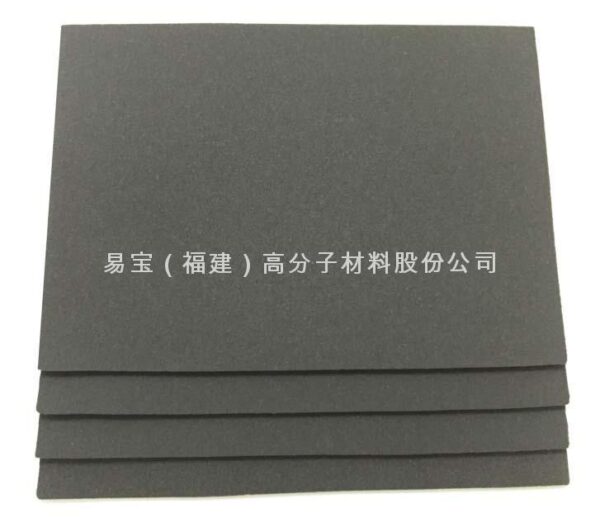
Industrial machinery and equipment cover seal
For machinery covers, the gasket may meet dust, vibration, heat, and repeated maintenance. Therefore, the seal must survive the actual environment rather than a simple desk test. General access covers may use EPDM-based cellular rubber, while hot covers may require silicone-based material.
Moreover, gasket width affects contact. A narrow seal line may not tolerate frame unevenness. A wider gasket may improve contact, although it may need more material and stronger closing pressure. Therefore, design should include both material and geometry.
Adhesive Backing and Converting: Turning Material Into a Usable Seal
Adhesive backing can make assembly faster and cleaner. It can also reduce fixture needs and help place a gasket more consistently. Therefore, many sealing strips and die-cut pads use pressure-sensitive adhesive.
However, adhesive backing does not work equally on every surface. Smooth metal, powder-coated steel, rough plastic, painted aluminum, glass, and textured housings can require different tape systems. In addition, surface dust, oil, mold release, or moisture can weaken bonding.
For this reason, adhesive selection should not happen at the final stage. Material, tape, liner, die-cut shape, and installation process should be tested together. A gasket that seals well may still fail if the adhesive cannot hold during assembly or service.

Why converting affects gasket performance
Material choice is only one part of the sealing system. Converting turns sheet material into a usable industrial part. Therefore, die cutting, slitting, lamination, adhesive backing, skiving, splitting, roll cutting, and packaging can decide whether the gasket installs smoothly.
For example, a straight strip may require clean slitting and stable width. A complex gasket may need die-cut corners, holes, tabs, or liner kiss cutting. Meanwhile, a thin pad may need controlled thickness and clean edges to avoid visual defects.
Additionally, material waste can affect cost. A long gasket, narrow strip, or special corner shape may require layout optimization. In some cases, roll or long-format material can improve utilization. Therefore, drawing review should include nesting, direction, and production yield.
How to Test Compression, Thickness, and Adhesive Backing Before Production
Testing should imitate the real assembly as closely as possible. Otherwise, a sample may pass a simple hand check but fail during production. Therefore, compression, thickness, adhesive behavior, surface contact, and temperature exposure should be reviewed together.
For cellular rubber projects, ASTM D1056 is a useful technical reference because it covers flexible cellular rubber materials and includes testing areas such as compression-deflection, aging, water absorption, density, and low-temperature flex. Therefore, it can help define clearer test language during technical discussions.
Compression testing
First, measure the open gap and the closed gap. Then compare gasket thickness with compressed height. This step shows whether the selected thickness is practical for the assembly.
Next, check closing force. A gasket may seal well but make a cover hard to close. In another case, it may feel easy to close but leave a weak contact line. Therefore, compression feel and seal contact should be reviewed together.
Thickness and tolerance testing
Second, thickness should be measured with a consistent method. Foam is compressible, so a heavy measuring force can make the sheet appear thinner. Therefore, the inspection method should remain stable across sample and production checks.
For strip gaskets, width tolerance also matters. A strip that is too wide may interfere with installation. A strip that is too narrow may not cover the contact area. In addition, die-cut parts need accurate holes, corners, and alignment features.
Adhesive testing
Third, adhesive testing should use the actual substrate. This is important because tapes bond differently to metal, plastic, coating, glass, rubber, and painted surfaces. Therefore, a desk test on a random panel does not represent production.
After application, the gasket should remain under realistic compression and temperature conditions. If the material pushes sideways, the adhesive may lift at corners or edges. Because of this, peel checks, compression checks, and storage checks should all be part of the sample review.
Sample Information Checklist for Faster Material Matching
A complete sample request helps reduce guesswork. It also shortens repeated sample rounds. Therefore, the following information should be prepared before comparing material options.
- Application name: enclosure gasket, weatherstrip, electronic pad, automotive seal, HVAC gasket, machinery cover seal, lighting seal, appliance gasket, or custom sealing part.
- Sealing purpose: dust control, air sealing, water splash resistance, vibration reduction, noise reduction, cushioning, thermal separation, or surface protection.
- Working environment: indoor, outdoor, covered outdoor, automotive interior, automotive exterior, industrial plant, equipment room, electronics housing, or heat-related area.
- Temperature condition: normal working range, highest expected temperature, lowest expected temperature, heat cycle frequency, and exposure time.
- Compression condition: open gap, closed gap, target compression range, closing force concern, and repeated opening frequency.
- Part shape: strip, pad, frame gasket, ring, washer, die-cut sheet, roll, long seal, or custom profile.
- Thickness target: sheet thickness, final compressed height, tolerance requirement, and measurement method.
- Surface contact: metal, plastic, glass, coated panel, painted surface, rubber surface, or textured housing.
- Adhesive requirement: no adhesive, single-sided adhesive, double-sided adhesive, heat-resistant tape, removable liner, split liner, or extended liner.
- Drawing details: PDF, CAD, DXF, sample photo, dimensions, holes, chamfers, radii, liner direction, and adhesive side.
How to Decide Between the Two Material Routes
First, start with the environment. Outdoor weather, ozone, and general sealing often point toward EPDM-based material. Heat, electronics, lighting, and demanding thermal zones often point toward silicone-based material. This first filter removes many unsuitable choices.
Next, check compression behavior. A seal that needs soft closure may require lower hardness or lower density. A seal that supports load may need more firmness. Therefore, material grade should match compression force, not only the polymer name.
Then, review production method. A simple strip may be easy to convert. A detailed frame gasket with adhesive backing may need die-cut planning, liner design, and packaging review. Because of this, processing needs can influence material selection.
After that, compare total value. EPDM-based material may offer strong value for volume outdoor sealing. Silicone-based material may cost more, yet it can reduce risk in high-temperature or precision sealing. Therefore, the lowest sheet price does not always create the best final part.
Finally, validate through samples. A short sample test can reveal fit, compression, adhesive behavior, surface contact, and installation speed. As a result, production decisions become more reliable.
Common Mistakes in Industrial Sealing Selection
One common mistake is choosing material by name only. A project may request a polymer family without defining gap, compression, surface, or temperature. However, sealing performance comes from the full system. Material, thickness, density, adhesive, geometry, and assembly pressure all matter.
Another mistake is ignoring tolerance. A drawing may show one gap, but production parts may vary. If the gasket cannot handle that range, leakage or closure problems may appear. Therefore, real assembly tolerance should guide thickness selection.
A third mistake is testing adhesive on the wrong surface. A tape that bonds well to clean stainless steel may not bond well to textured plastic or powder-coated metal. Therefore, adhesive trials should use the real production surface.
Moreover, some projects test only at room temperature. This can miss heat, cold, and humidity behavior. If the final part faces outdoor or high-temperature conditions, the test should include those conditions.
Finally, many projects separate material selection from converting design. This can lead to waste, difficult installation, or inconsistent edge quality. Therefore, material and processing should be reviewed together from the first sample round.
FAQ
Is EPDM-based cellular rubber better for outdoor sealing?
Generally, EPDM-based cellular rubber is a strong option for many outdoor sealing applications. It performs well where weather, ozone, moisture, and aging resistance matter. Therefore, it often fits enclosure gaskets, weatherstrips, automotive seals, HVAC seals, and building-related strips. However, final selection still depends on temperature, compression, shape, adhesive backing, and surface contact.
When should silicone-based cellular rubber be selected?
Silicone-based cellular rubber should be considered when heat, thermal cycling, soft compression, or demanding electronics-related sealing matters. It is often suitable for LED lighting gaskets, electronic pads, heater-adjacent seals, control panels, power housings, and precision equipment gaskets. However, it should be selected for a clear performance reason because it often carries a higher cost direction.
Can both materials use adhesive backing?
Yes. Both material routes can use adhesive backing when the correct tape system and surface preparation are selected. However, adhesive performance depends on the actual substrate, surface cleanliness, compression stress, temperature, dwell time, and liner design. Therefore, adhesive-backed samples should be tested on the real assembly surface before production.
What sample information should be provided?
A practical sample request should include application, working temperature, outdoor or indoor exposure, open gap, closed gap, target compression, part drawing, thickness, adhesive needs, substrate material, quantity stage, and assembly method. In addition, photos or existing samples can help define shape and installation details.
How should compression be tested before production?
Compression testing should use the real part shape and installation surface whenever possible. First, measure the open and closed gap. Next, install several thickness options and check closure force, contact line, rebound, and edge behavior. Then, add temperature or aging checks if the final application requires them.
Summary and Practical Next Steps
In short, EPDM-based and silicone-based cellular rubber should be selected by sealing environment, compression behavior, temperature risk, adhesive method, and converting plan. The best industrial gasket is not chosen by polymer name alone. Instead, it comes from a clear match between material, thickness, density, part shape, surface, and production process.
- First, define the sealing environment before requesting samples. Include temperature, outdoor exposure, compression gap, surface material, and sealing purpose.
- Second, compare two or three sample thicknesses under real assembly pressure. Check closing force, recovery, adhesive movement, and edge quality.
- Finally, prepare gasket drawings, substrate details, and adhesive requirements so material and converting recommendations can match the final production method.