
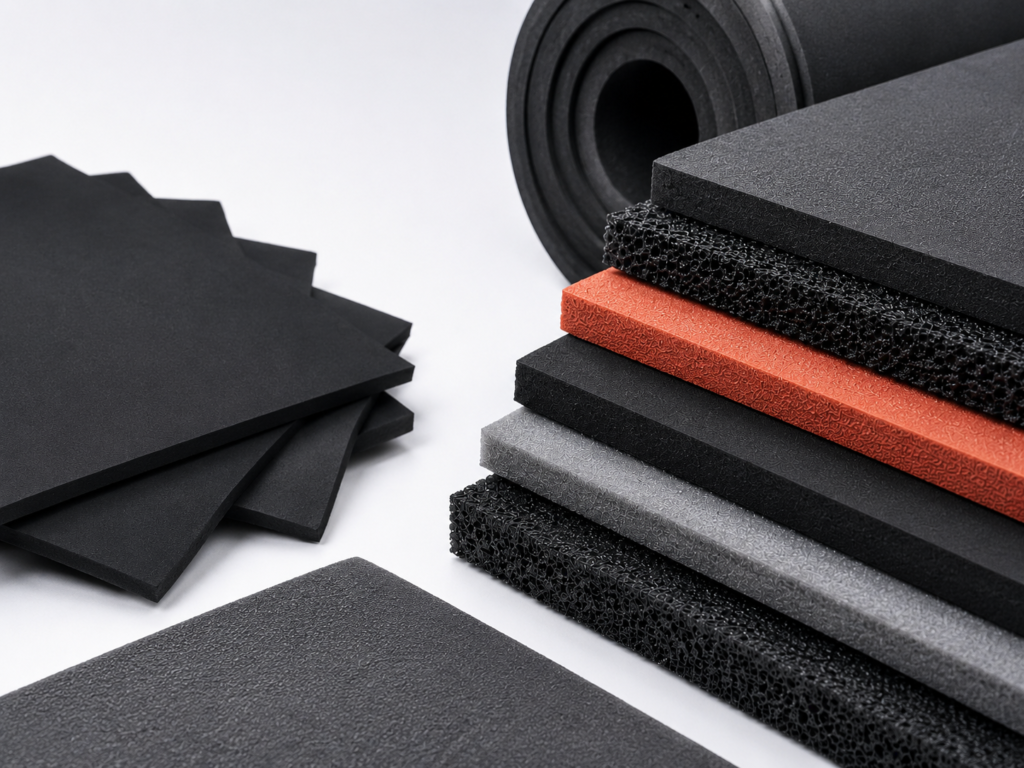
In sealing, cushioning, insulation, and converted gasket projects, rubber foam should be selected by the conditions the finished part must survive, not by color or thickness alone. EPDM, neoprene, silicone, and NBR/PVC can all work well, but they solve different combinations of weather exposure, heat, oil contact, compression, lamination, adhesive backing, and conversion.
Quick Navigation
Choose the Rubber Foam by What the Finished Part Must Handle
A gasket mounted outdoors should not be evaluated the same way as a fabric-laminated sleeve, a heat-adjacent cabinet seal, or an industrial pad near oil and machinery. The useful starting point is the finished assembly: where the part sits, what reaches it, how much it is compressed, and how it will be processed.
This page focuses only on four rubber-foam families—EPDM, neoprene, silicone, and NBR/PVC. It is not intended to repeat a broad foam-material guide covering PE, EVA, and every specialty foam type. The goal is to help buyers who already know they need a rubber-based foam narrow the right candidate before sampling.
Exposure comes first
Weather, temperature, oil, moisture, dust, vibration, and long compression quickly narrow the candidate list.
Check the actual function
Sealing, cushioning, insulation, spacing, gap filling, and fabric lamination place different demands on the foam.
Approve the finished structure
Thickness, adhesive, die cutting, lamination, sewing, and assembly pressure can change how a good sheet performs.
A useful early-selection sequence
Define the harshest working condition, identify the part function, and shortlist the material family. Only then should thickness, density, adhesive backing, and conversion method be finalized.
The final check belongs in the real assembly. A sheet that looks correct on a sample table may behave very differently after compression, bending, bonding, closing, or long-term installation.
EPDM Foam for Weather Sealing, Outdoor Gaskets and Automotive Pads
EPDM is often the strongest starting candidate when outdoor weather is the main challenge. Enclosure gaskets, weather strips, automotive pads, lighting seals, appliance seals, cabinet strips, and exterior equipment parts all depend on continued contact after moisture, dust, sunlight, temperature movement, and repeated closing.
For these parts, initial softness is only part of the decision. A seal must continue filling the gap after it has been compressed for a long period or repeatedly opened and closed. Recovery and the actual closing force are more useful evaluation points than appearance alone.
EPDM is less compelling when fabric lamination, soft-goods handling, or direct oil exposure controls the design. Those conditions may justify evaluating another family before the project moves into tooling.
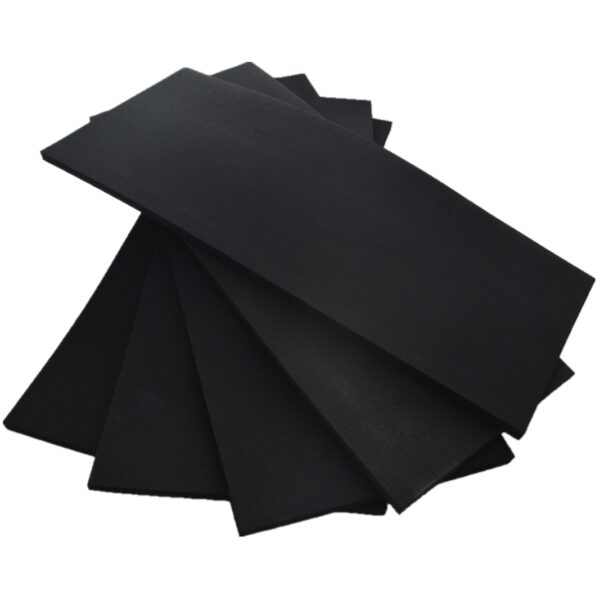
Review EPDM sheet options for weather strips, enclosure seals, automotive pads, outdoor equipment gaskets, and converted sealing parts.
View EPDM Foam CategoryWhere EPDM commonly fits
- Outdoor electrical enclosure gaskets and access-panel seals.
- Automotive lamp pads, trim strips, housing seals, and contact pads.
- Appliance door strips, HVAC pads, and equipment-cover gaskets.
- Parts that must block dust or moisture while maintaining long-term contact.
Thickness and compression must be checked together
A thicker gasket can bridge a larger or less consistent gap, but excess thickness can raise door or cover closing force. A thinner gasket may assemble easily yet lose contact where panels are uneven.
Drawings should show the expected gap range, part tolerance, target compression, and adhesive requirement. Sample approval should include the actual cover, door, or panel rather than relying only on uncompressed sheet thickness.
Neoprene Foam for Lamination, Flexible Protection and Soft Goods
Neoprene-related CR, SBR, and SCR materials become more relevant when a product must bend, wrap, laminate, sew, or remain comfortable in use. Typical projects include sports supports, sleeves, bags, protective covers, footwear parts, and flexible cushioning structures.
Fabric is often part of the finished performance rather than a cosmetic layer. Nylon, polyester, jersey, and other laminated surfaces can change abrasion resistance, stretch, surface feel, cutting behavior, and the way the finished part handles during sewing or bonding.
This makes neoprene different from an outdoor gasket choice based mainly on weather resistance. When the key questions are movement, hand feel, lamination, and fabrication, the complete laminated structure deserves testing—not only the bare foam core.

Compare neoprene, SBR, SCR, and CR sheet options for laminated supports, sleeves, soft protective products, flexible pads, and converted components.
Compare Neoprene / SBR / SCR / CRWhere neoprene-related sheets commonly fit
- Sports supports, braces, sleeves, and flexible protective goods.
- Bag panels, laptop sleeves, bottle holders, and soft protective covers.
- Fabric-laminated sheets for cutting, sewing, bonding, and edge finishing.
- Flexible pads where bending response and cushioning feel matter together.
Do not approve the foam core separately from the finished laminate
Thickness, density, fabric type, stretch direction, surface finish, and adhesive system can change the finished feel. A sheet that bends well before lamination may become too stiff after fabric bonding, sewing, or edge finishing.
Sample evaluation should include bending, cutting, sewing or bonding, surface durability, and the final movement expected in use.
Silicone Foam for Heat-Adjacent and Technical Sealing
Silicone foam becomes a serious candidate when temperature, recovery, gap filling, or technical sealing matters more than general cushioning cost. It is commonly considered for electronics housings, electrical cabinets, lighting assemblies, battery-related equipment, industrial machinery, and heat-adjacent gasket designs.
The useful question is not whether the application sounds “technical.” It is whether the actual operating condition requires silicone’s performance. A room-temperature protection pad with no demanding recovery or heat exposure may be better served by a more practical material.
When silicone is justified, the part still has to work mechanically. Compression, thickness, bonding method, gasket-wall width, hole size, and installation pressure should be reviewed before production approval.
Review silicone foam options when temperature, technical sealing, recovery, gap filling, or heat-adjacent installation conditions are central to the part.
View Silicone Foam CategoryWhere silicone foam commonly fits
- Electronics enclosure gaskets and electrical cabinet seals.
- Heat-adjacent equipment pads and cover gaskets.
- Lighting housings, appliances, and technical gap-filling parts.
- Soft sealing positions where stable recovery and contact pressure matter.
Check the grade and adhesive system, not only the material name
Temperature requirement, compression behavior, density, cell structure, bonding method, and any required test standard should be confirmed against the actual grade and sample. Silicone surfaces may also require a different adhesive approach from EPDM or neoprene.
Sample validation should cover fit, compression, peel behavior, liner handling, and assembly pressure. Small holes, narrow walls, and detailed die-cut shapes should also be reviewed before tooling approval.
NBR/PVC Foam for Oil-Contact Environments, Insulation and Industrial Pads
NBR/PVC becomes more relevant when the finished part sits around machinery, may encounter oil, needs insulation, or functions as an industrial protective pad. Common formats include equipment pads, sealing strips, insulation components, adhesive-backed pieces, and converted cushioning parts.
This separates it from EPDM in many early comparisons. If weather exposure is the dominant requirement, EPDM may remain the stronger candidate. If direct or repeated oil contact, machine surroundings, or insulation controls the design, NBR/PVC deserves earlier sample review.
Mixed environments need more care. “Near machinery” is not specific enough to approve a material; the inquiry should identify what fluid is present, whether contact is occasional or continuous, and what other conditions the pad or gasket must handle.
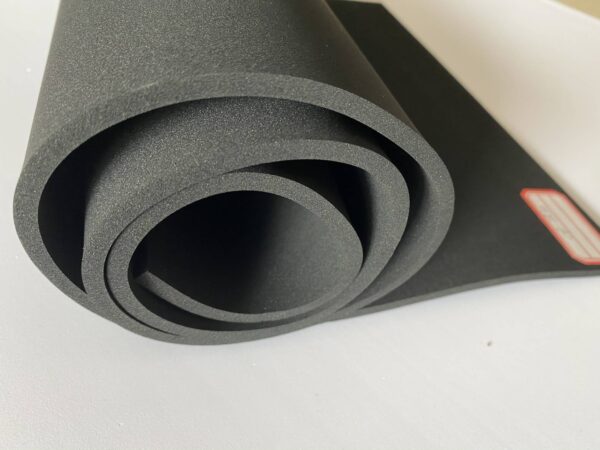
Review NBR/PVC foam options for industrial pads, machinery surroundings, insulation parts, adhesive-backed strips, and converted protective components.
Check NBR/PVC Foam OptionsWhere NBR/PVC commonly fits
- Machinery pads, industrial strips, and equipment cushioning parts.
- Appliance, HVAC, and pipe-related insulation applications.
- Automotive door, trunk, tail-light, and vibration-control parts where the environment suits the grade.
- Shock-protection and support pads for equipment, instruments, or manufactured assemblies.
Describe the exposure before specifying thickness
Fluid contact, vibration, surface pressure, insulation function, and compression direction should be known before thickness is finalized. Otherwise, the project can end up with a pad that is either unnecessarily heavy or unable to maintain the required fit.
Drawings should include part size, use position, compression direction, adhesive requirement, and final format. When several exposures overlap, comparing NBR/PVC with one other candidate in the real assembly is more useful than choosing from a material name alone.
EPDM vs Neoprene vs Silicone vs NBR/PVC: Practical Comparison
This matrix is designed for early shortlisting. It helps identify which material deserves sample testing first; it does not replace the actual grade datasheet, drawing review, adhesive test, or finished-assembly validation.
| Selection Factor | EPDM | Neoprene / SBR / SCR / CR | Silicone | NBR/PVC |
|---|---|---|---|---|
| Best starting point | Weather sealing and outdoor pads | Lamination and flexible protection | Heat-adjacent technical sealing | Oil-contact environments, insulation, industrial pads |
| Typical environment | Moisture, dust, weather exposure | Soft goods, flexible pads, laminated products | Heat-adjacent or demanding sealing positions | Machinery surroundings, oil contact, insulation |
| Common finished parts | Gaskets, weather strips, pads, enclosure seals | Sleeves, supports, covers, fabric-laminated sheets | Gaskets, gap fillers, cabinet seals, technical pads | Pads, strips, insulation parts, equipment protection |
| Compression focus | Long-contact sealing and recovery | Flexible resilience and hand feel | Recovery under demanding conditions | Industrial support and pad stability |
| Common processing | Die-cut gaskets, strips, adhesive-backed pads | Lamination, sheet cutting, skiving, sewing support | Die-cut seals, strips, technical pads | Sheet cutting, strip cutting, adhesive pads |
| Ask this question first | Is weather the harshest exposure? | Does the product need fabric, bending, or soft handling? | Does the sealing position face meaningful heat? | Will oil contact, machinery, or insulation control the choice? |
Where a project requires a recognized cellular-material specification, the requested standard and grade should be confirmed against the final drawing and sample requirement. For example, ASTM D1056 covers flexible cellular materials such as sponge and expanded rubber.
When Two Conditions Point to Different Materials
Real projects rarely arrive with only one requirement. Weather may appear together with heat, oil contact may occur outdoors, or a laminated product may also need environmental resistance. In these cases, the correct choice depends on which condition is actually limiting the finished part.
Outdoor enclosure: EPDM or silicone?
Do not choose silicone simply because the enclosure contains electronics. Check the temperature at the gasket position. If the gasket itself stays within a normal outdoor sealing environment and weather is the harder condition, EPDM may remain the practical candidate.
If the sealing line is exposed to sustained or significant heat, compare EPDM and silicone samples using the real cover, compression level, adhesive, and operating condition. The hottest internal component is less useful than the actual temperature seen by the gasket.
Machinery gasket: NBR/PVC or EPDM?
“Used near machinery” is not enough information. Confirm whether oil reaches the foam directly, how often contact occurs, and whether outdoor weather remains a major exposure.
If oil contact controls service life, NBR/PVC deserves early testing. If exposure is mainly rain, dust, sunlight, and outdoor sealing with little or no fluid contact, EPDM may be more relevant. Mixed conditions should be compared using the harshest realistic service case.
Flexible laminated product: neoprene or an outdoor-sealing material?
Start by identifying what the foam is doing. A sleeve, protective cover, or wearable part that must bend and carry fabric is still a lamination problem, so neoprene-related materials may remain the more logical starting point.
A fixed gasket whose main job is to block weather should be evaluated as a seal instead. The product name matters less than whether the foam is acting as a flexible laminated structure or as an environmental sealing interface.
The gasket seals, but closing force is too high—do you need another material?
Not necessarily. Excessive closing force can come from too much thickness, excessive compression, unsuitable density, or the way the gasket is positioned. Changing the entire material family before checking these variables may create a new problem without fixing the original one.
Measure the installed gap, compare it with uncompressed thickness, review the expected compression range, and test a second thickness or grade in the same assembly. Material family should change only when the environment or performance requirement points in that direction.
The Material Still Has to Convert Into a Stable Part
A suitable foam sheet is only the first half of the decision. The material still has to become a repeatable gasket, strip, pad, laminated sheet, or adhesive-backed component. Die cutting, slitting, skiving, lamination, backing, and packaging should be discussed before the production material is locked.
YIBAO Foam can review sheet supply and converted-part requirements against drawings and sample parts. Common output formats include foam sheets, slit rolls, strips, fabric-laminated sheets, die-cut pads, adhesive-backed gaskets, and custom converted pieces.
Die-cut gaskets
Review holes, narrow walls, tolerance, part nesting, adhesive backing, and repeatability before tooling approval.
Laminated sheets
Evaluate foam, fabric, adhesive, stretch direction, sewing or bonding, and final stiffness as one structure.
Adhesive-backed parts
Test the real substrate, liner release, installation pressure, positioning method, and finished peel behavior.
Adhesive failure does not always mean the foam is wrong
Painted metal, powder-coated panels, plastics, rubber surfaces, and textured housings can bond very differently. When the foam itself passes compression and environmental testing but the backing lifts, test the adhesive system and substrate preparation before replacing the foam family.
What to Prepare Before Requesting Samples or a Quote
A useful inquiry does not need to start with an exact grade number. If the working conditions and part design are clear, the supplier can compare suitable candidates without forcing the buyer to guess the material first.
Prepare these project details
- Application: enclosure gasket, automotive pad, sleeve sheet, machinery strip, insulation part, spacer, or other finished component.
- Working environment: outdoor weather, temperature exposure, oil or fluid contact, moisture, dust, vibration, and long-term compression.
- Drawing: length, width, thickness, holes, narrow sections, tolerance, installed gap, and available sealing space.
- Compression requirement: expected installed gap, acceptable closing force, and whether repeated opening or long static compression is expected.
- Material status: EPDM, neoprene, silicone, NBR/PVC, an existing reference sample, or an open material comparison.
- Finished format: sheet, roll, slit strip, die-cut pad, laminated sheet, adhesive-backed gasket, or custom converted part.
- Bonding surface: painted metal, powder-coated panel, plastic, fabric, rubber, or another installation substrate.
- Quantity and packaging: sample quantity, estimated production volume, loose pieces, sheet format, rolls, or kiss-cut liner layout.
A better way to approve samples
When the correct family is not obvious, compare two realistic candidates rather than requesting many unrelated sheets. Use the harshest expected condition to decide which two belong in the test.
Install the samples in the actual assembly and check gap filling, closing force, recovery, adhesive behavior, bending or movement, and edge stability. Touch and appearance alone do not show whether the part will work after installation.
Conversion should be confirmed before mass-production approval. Narrow strips, small holes, thin bridges, adhesive liners, and complex die-cut shapes can behave differently from a simple rectangular sheet sample.
FAQ
Send the Assembly Conditions Before Locking the Material
If two materials still look possible after the first comparison, the next step is not another generic material list. Compare samples against the conditions that can actually cause the finished part to fail.
For sample planning or a converted-part quotation, send the drawing, installed gap, working temperature and exposure, oil or fluid contact if relevant, bonding surface, required part format, and estimated quantity. This gives YIBAO Foam enough information to review the material and the finished-part process together.